This article is about generating functions in physics. For generating functions in mathematics, see Generating function.
Generating a sine from a circle.
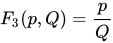
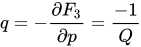
In physics, and more specifically in Hamiltonian mechanics, a generating function is, loosely, a function whose partial derivatives generate the differential equations that determine a system's dynamics. Common examples are the partition function of statistical mechanics, the Hamiltonian, and the function which acts as a bridge between two sets of canonical variables when performing a canonical transformation.
error) Generating function (math) Generating function (physics) Generating set Generating set of a group Generating trigonometric tables Generating a curve
the cumulant generating function (CGF) K(t), which is a generating function that is the natural logarithm of the moment generating function: K ( t ) = log
academic field of plasma science or plasma physics, including several sub-disciplines such as space plasma physics. Plasmas can appear in nature in various
Quantum mechanics, also known as quantum physics, is the fundamental physical theory that describes the behavior of matter and of light; its unusual characteristics
In theoretical physics, specifically quantum field theory, a beta function or Gell-Mann–Low function, β(g), encodes the dependence of a coupling parameter
In quantum field theory, partition functions are generating functionals for correlation functions, making them key objects of study in the path integral
probability density function (PDF), density function, or simply density of an absolutely continuous random variable, is a function whose value at any given