📑 Table of Contents

The zero lag exponential moving average (ZLEMA) is a technical indicator within technical analysis that aims is to eliminate the inherent lag associated to all trend following indicators which average a price over time. As is the case with the double exponential moving average (DEMA) and the triple exponential moving average (TEMA) this indicator aims to reduce the lag.

History

edit

The indicator was created by John Ehlers and Ric Way around 2010.[1]

Formula

edit

The formula for a given N-Day period and for a given data series is:[2][3]
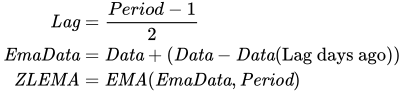
The idea is do a regular exponential moving average (EMA) calculation but on a de-lagged data instead of doing it on the regular data. Data is de-lagged by removing the data from "lag" days ago thus removing (or attempting to) the cumulative effect of the moving average.

References

edit

📚 Artikel Terkait di Wikipedia

Moving average

recent data, down to zero. It can be compared to the weights in the exponential moving average which follows. An exponential moving average (EMA), also known

Autoregressive integrated moving average

autoregressive integrated moving average (ARIMA) and seasonal ARIMA (SARIMA) models are generalizations of the autoregressive moving average (ARMA) model to non-stationary

MACD

a "fast" (short period) exponential moving average (EMA), and a "slow" (longer period) EMA of the price series. The average series is an EMA of the MACD

Box–Jenkins method

and Gwilym Jenkins, applies autoregressive moving average (ARMA) or autoregressive integrated moving average (ARIMA) models to find the best fit of a time-series

Autoregressive model

process equals zero at lags larger than p, so the appropriate maximum lag p is the one after which the partial autocorrelations are all zero. There are many

Autoregressive conditional heteroskedasticity

ARCH and GARCH errors. Exponentially weighted moving average (EWMA) is an alternative model in a separate class of exponential smoothing models. As an

Correlogram

should be near zero for any and all time-lag separations. If non-random, then one or more of the autocorrelations will be significantly non-zero. In addition

Autocorrelation

the estimation of a moving average model (MA), the autocorrelation function is used to determine the appropriate number of lagged error terms to be included