This article has multiple issues. Please help improve it or discuss these issues on the talk page. (Learn how and when to remove these messages)
|
In applied mathematics, Wahba's problem, first posed by Grace Wahba in 1965, seeks to find a rotation matrix (special orthogonal matrix) between two coordinate systems from a set of (weighted) vector observations. Solutions to Wahba's problem are often used in satellite attitude determination utilising sensors such as magnetometers and multi-antenna GPS receivers. The cost function that Wahba's problem seeks to minimise is as follows:
- for
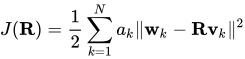

where is the k-th 3-vector measurement in the reference frame, is the corresponding k-th 3-vector measurement in the body frame and is a 3 by 3 rotation matrix between the coordinate frames.[1] is an optional set of weights for each observation.


A number of solutions to the problem have appeared in literature, notably Davenport's q-method,[2] QUEST and methods based on the singular value decomposition (SVD). Several methods for solving Wahba's problem are discussed by Markley and Mortari.
This is an alternative formulation of the orthogonal Procrustes problem (consider all the vectors multiplied by the square-roots of the corresponding weights as columns of two matrices with N columns to obtain the alternative formulation). A compact and elegant derivation can be found in Appel (2015).[3]
Solution via SVD
editOne solution can be found using a singular value decomposition (SVD).
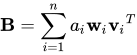
1. Obtain a matrix as follows:

2. Find the singular value decomposition of

3. The rotation matrix is simply:
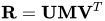
where

Notes
edit- ^ The rotation in the problem's definition transforms the body frame to the reference frame. Most publications define rotation in the reverse direction, i.e. from the reference to the body frame which amounts to .
- ^ "Davenport's Q-method (Finding an orientation matching a set of point samples)". Mathematics Stack Exchange. Retrieved 2020-07-23.
- ^ Appel, M. "Robust Spoofing Detection and Mitigation based on Direction of Arrival Estimation" (PDF). Ion GNSS+ 2015. 28.

References
edit- Wahba, G. Problem 65–1: A Least Squares Estimate of Satellite Attitude, SIAM Review, 1965, 7(3), 409
- Shuster, M. D. and Oh, S. D. Three-Axis Attitude Determination from Vector Observations, Journal of Guidance and Control, 1981, 4(1):70–77
- Markley, F. L. Attitude Determination using Vector Observations and the Singular Value Decomposition, Journal of the Astronautical Sciences, 1988, 38:245–258
- Markley, F. L. and Mortari, D. Quaternion Attitude Estimation Using Vector Observations, Journal of the Astronautical Sciences, 2000, 48(2):359–380
- Markley, F. L. and Crassidis, J. L. Fundamentals of Spacecraft Attitude Determination and Control, Springer 2014
- Libbus, B. and Simons, G. and Yao, Y. Rotating Multiple Sets of Labeled Points to Bring Them Into Close Coincidence: A Generalized Wahba Problem, The American Mathematical Monthly, 2017, 124(2):149–160
- Lourakis, M. and Terzakis, G. Efficient Absolute Orientation Revisited, IEEE/RSJ International Conference on Intelligent Robots and Systems (IROS), 2018, pp. 5813-5818.
