The Kabsch algorithm, also known as the Kabsch-Umeyama algorithm,[1] named after Wolfgang Kabsch and Shinji Umeyama, is a method for calculating the optimal rotation matrix that minimizes the RMSD (root mean squared deviation) between two paired sets of points. It is useful for point-set registration in computer graphics, and in cheminformatics and bioinformatics to compare molecular and protein structures (in particular, see root-mean-square deviation (bioinformatics)).
The algorithm only computes the rotation matrix, but it also requires the computation of a translation vector. When both the translation and rotation are actually performed, the algorithm is sometimes called partial Procrustes superimposition (see also orthogonal Procrustes problem).
Description
editLet P and Q be two sets, each containing N points in . We want to find the transformation from Q to P. For simplicity, we will consider the three-dimensional case (). The sets P and Q can each be represented by N × 3 matrices with the first row containing the coordinates of the first point, the second row containing the coordinates of the second point, and so on, as shown in this matrix:


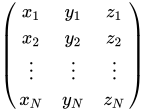
The algorithm works in three steps: a translation, the computation of a covariance matrix, and the computation of the optimal rotation matrix.
Translation
editBoth sets of coordinates must be translated first, so that their centroid coincides with the origin of the coordinate system. This is done by subtracting the centroid coordinates from the point coordinates.
Computation of the covariance matrix
editThe second step consists of calculating a matrix H. In matrix notation,

or, using summation notation,
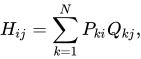
which is a cross-covariance matrix when P and Q are seen as data matrices.
Computation of the optimal rotation matrix
editIt is possible to calculate the optimal rotation R based on the matrix formula
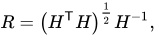
but implementing a numerical solution to this formula becomes complicated when all special cases are accounted for (for example, the case of H not having an inverse).
If singular value decomposition (SVD) routines are available the optimal rotation, R, can be calculated using the following algorithm.
First, calculate the SVD of the covariance matrix H,

where U and V are orthogonal and is diagonal. Next, record if the orthogonal matrices contain a reflection,


Finally, calculate our optimal rotation matrix R as
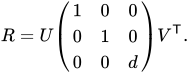
This R minimizes , where and are rows in Q and P respectively.


Alternatively, optimal rotation matrix can also be directly evaluated as quaternion.[2][3][4][5] This alternative description has been used in the development of a rigorous method for removing rigid-body motions from molecular dynamics trajectories of flexible molecules.[6] In 2002 a generalization for the application to probability distributions (continuous or not) was also proposed.[7]
Generalizations
editThe algorithm was described for points in a three-dimensional space. The generalization to D dimensions is immediate.
External links
editThis SVD algorithm is described in more detail at https://web.archive.org/web/20140225050055/http://cnx.org/content/m11608/latest/
A Matlab function is available at http://www.mathworks.com/matlabcentral/fileexchange/25746-kabsch-algorithm
A Python script is available at https://github.com/charnley/rmsd. Another implementation can be found in SciPy.
A free PyMol plugin easily implementing Kabsch is [1]. (This previously linked to CEalign [2], but this uses the Combinatorial Extension (CE) algorithm.) VMD uses the Kabsch algorithm for its alignment.
The FoldX modeling toolsuite incorporates the Kabsch algorithm to measure RMSD between Wild Type and Mutated protein structures.
See also
editReferences
edit- ^ Lawrence, Jim; Bernal, Javier; Witzgall, Christoph (2019-10-09). "A Purely Algebraic Justification of the Kabsch-Umeyama Algorithm" (PDF). Journal of Research of the National Institute of Standards and Technology. 124: 124028. doi:10.6028/jres.124.028. ISSN 2165-7254. PMC 7340555. PMID 34877177.
- ^ Horn, Berthold K. P. (1987-04-01). "Closed-form solution of absolute orientation using unit quaternions". Journal of the Optical Society of America A. 4 (4): 629. Bibcode:1987JOSAA...4..629H. CiteSeerX 10.1.1.68.7320. doi:10.1364/josaa.4.000629. ISSN 1520-8532. S2CID 11038004.
- ^ Kneller, Gerald R. (1991-05-01). "Superposition of Molecular Structures using Quaternions". Molecular Simulation. 7 (1–2): 113–119. doi:10.1080/08927029108022453. ISSN 0892-7022.
- ^ Coutsias, E. A.; Seok, C.; Dill, K. A. (2004). "Using quaternions to calculate RMSD". J. Comput. Chem. 25 (15): 1849–1857. doi:10.1002/jcc.20110. PMID 15376254. S2CID 18224579.
- ^ Petitjean, M. (1999). "On the root mean square quantitative chirality and quantitative symmetry measures" (PDF). J. Math. Phys. 40 (9): 4587–4595. Bibcode:1999JMP....40.4587P. doi:10.1063/1.532988.
- ^ Chevrot, Guillaume; Calligari, Paolo; Hinsen, Konrad; Kneller, Gerald R. (2011-08-24). "Least constraint approach to the extraction of internal motions from molecular dynamics trajectories of flexible macromolecules". J. Chem. Phys. 135 (8): 084110. Bibcode:2011JChPh.135h4110C. doi:10.1063/1.3626275. ISSN 0021-9606. PMID 21895162.
- ^ Petitjean, M. (2002). "Chiral mixtures" (PDF). J. Math. Phys. 43 (8): 4147–4157. Bibcode:2002JMP....43.4147P. doi:10.1063/1.1484559. S2CID 85454709.
- Kabsch, Wolfgang (1976). "A solution for the best rotation to relate two sets of vectors". Acta Crystallographica. A32 (5): 922. Bibcode:1976AcCrA..32..922K. doi:10.1107/S0567739476001873.
- With a correction in Kabsch, Wolfgang (1978). "A discussion of the solution for the best rotation to relate two sets of vectors". Acta Crystallographica. A34 (5): 827–828. Bibcode:1978AcCrA..34..827K. doi:10.1107/S0567739478001680.
- Lin, Ying-Hung; Chang, Hsun-Chang; Lin, Yaw-Ling (December 15–17, 2004). A Study on Tools and Algorithms for 3-D Protein Structures Alignment and Comparison. International Computer Symposium. Taipei, Taiwan.
- Umeyama, Shinji (1991). "Least-Squares Estimation of Transformation Parameters Between Two Point Patterns". IEEE Trans. Pattern Anal. Mach. Intell. 13 (4): 376–380. doi:10.1109/34.88573.
