The value function of an optimization problem gives the value attained by the objective function at a solution, while only depending on the parameters of the problem.[1][2] In a controlled dynamical system, the value function represents the optimal payoff of the system over the interval when started at the time- state variable .[3] If the objective function represents some cost that is to be minimized, the value function can be interpreted as the cost to finish the optimal program, and is thus referred to as "cost-to-go function."[4][5] In an economic context, where the objective function usually represents utility, the value function is conceptually equivalent to the indirect utility function.[6][7]
![{\displaystyle [t,t_{1}]}](https://wikimedia.org/api/rest_v1/media/math/render/svg/101affd7d224a609b6db499492544f2e14b43eb8)


In a problem of optimal control, the value function is defined as the supremum of the objective function taken over the set of admissible controls. Given , a typical optimal control problem is to
![{\displaystyle (t_{0},x_{0})\in [0,t_{1}]\times \mathbb {R} ^{d}}](https://wikimedia.org/api/rest_v1/media/math/render/svg/61b7207b5b16cedc34a560f756549722cedc590c)

subject to
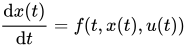
with initial state variable .[8] The objective function is to be maximized over all admissible controls , where is a Lebesgue measurable function from to some prescribed arbitrary set in . The value function is then defined as


![{\displaystyle u\in U[t_{0},t_{1}]}](https://wikimedia.org/api/rest_v1/media/math/render/svg/81b991151ca37b1da4a5b43ddd0a100a1a25e83f)

![{\displaystyle [t_{0},t_{1}]}](https://wikimedia.org/api/rest_v1/media/math/render/svg/ffe2ab6560fe2acf9a63ad878ad482164b79012d)


with , where is the "scrap value". If the optimal pair of control and state trajectories is , then . The function that gives the optimal control based on the current state is called a feedback control policy,[4] or simply a policy function.[9]






Bellman's principle of optimality roughly states that any optimal policy at time , taking the current state as "new" initial condition must be optimal for the remaining problem. If the value function happens to be continuously differentiable,[10] this gives rise to an important partial differential equation known as Hamilton–Jacobi–Bellman equation,



where the maximand on the right-hand side can also be re-written as the Hamiltonian, , as


with playing the role of the costate variables.[11] Given this definition, we further have , and after differentiating both sides of the HJB equation with respect to ,



which after replacing the appropriate terms recovers the costate equation
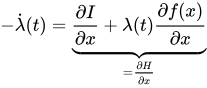
where is Newton notation for the derivative with respect to time.[12]

The value function is the unique viscosity solution to the Hamilton–Jacobi–Bellman equation.[13] In an online closed-loop approximate optimal control, the value function is also a Lyapunov function that establishes global asymptotic stability of the closed-loop system.[14]
References
edit- ^ Fleming, Wendell H.; Rishel, Raymond W. (1975). Deterministic and Stochastic Optimal Control. New York: Springer. pp. 81–83. ISBN 0-387-90155-8.
- ^ Caputo, Michael R. (2005). Foundations of Dynamic Economic Analysis : Optimal Control Theory and Applications. New York: Cambridge University Press. p. 185. ISBN 0-521-60368-4.
- ^ Weber, Thomas A. (2011). Optimal Control Theory : with Applications in Economics. Cambridge: The MIT Press. p. 82. ISBN 978-0-262-01573-8.
- ^ a b Bertsekas, Dimitri P.; Tsitsiklis, John N. (1996). Neuro-Dynamic Programming. Belmont: Athena Scientific. p. 2. ISBN 1-886529-10-8.
- ^ "EE365: Dynamic Programming" (PDF).
- ^ Mas-Colell, Andreu; Whinston, Michael D.; Green, Jerry R. (1995). Microeconomic Theory. New York: Oxford University Press. p. 964. ISBN 0-19-507340-1.
- ^ Corbae, Dean; Stinchcombe, Maxwell B.; Zeman, Juraj (2009). An Introduction to Mathematical Analysis for Economic Theory and Econometrics. Princeton University Press. p. 145. ISBN 978-0-691-11867-3.
- ^ Kamien, Morton I.; Schwartz, Nancy L. (1991). Dynamic Optimization : The Calculus of Variations and Optimal Control in Economics and Management (2nd ed.). Amsterdam: North-Holland. p. 259. ISBN 0-444-01609-0.
- ^ Ljungqvist, Lars; Sargent, Thomas J. (2018). Recursive Macroeconomic Theory (Fourth ed.). Cambridge: MIT Press. p. 106. ISBN 978-0-262-03866-9.
- ^ Benveniste and Scheinkman established sufficient conditions for the differentiability of the value function, which in turn allows an application of the envelope theorem, see Benveniste, L. M.; Scheinkman, J. A. (1979). "On the Differentiability of the Value Function in Dynamic Models of Economics". Econometrica. 47 (3): 727–732. doi:10.2307/1910417. JSTOR 1910417. Also see Seierstad, Atle (1982). "Differentiability Properties of the Optimal Value Function in Control Theory". Journal of Economic Dynamics and Control. 4: 303–310. doi:10.1016/0165-1889(82)90019-7.
- ^ Kirk, Donald E. (1970). Optimal Control Theory. Englewood Cliffs, NJ: Prentice-Hall. p. 88. ISBN 0-13-638098-0.
- ^ Zhou, X. Y. (1990). "Maximum Principle, Dynamic Programming, and their Connection in Deterministic Control". Journal of Optimization Theory and Applications. 65 (2): 363–373. doi:10.1007/BF01102352. S2CID 122333807.
- ^ Theorem 10.1 in Bressan, Alberto (2019). "Viscosity Solutions of Hamilton-Jacobi Equations and Optimal Control Problems" (PDF). Lecture Notes.
- ^ Kamalapurkar, Rushikesh; Walters, Patrick; Rosenfeld, Joel; Dixon, Warren (2018). "Optimal Control and Lyapunov Stability". Reinforcement Learning for Optimal Feedback Control: A Lyapunov-Based Approach. Berlin: Springer. pp. 26–27. ISBN 978-3-319-78383-3.
Further reading
edit- Caputo, Michael R. (2005). "Necessary and Sufficient Conditions for Isoperimetric Problems". Foundations of Dynamic Economic Analysis : Optimal Control Theory and Applications. New York: Cambridge University Press. pp. 174–210. ISBN 0-521-60368-4.
- Clarke, Frank H.; Loewen, Philip D. (1986). "The Value Function in Optimal Control: Sensitivity, Controllability, and Time-Optimality". SIAM Journal on Control and Optimization. 24 (2): 243–263. doi:10.1137/0324014.
- LaFrance, Jeffrey T.; Barney, L. Dwayne (1991). "The Envelope Theorem in Dynamic Optimization" (PDF). Journal of Economic Dynamics and Control. 15 (2): 355–385. doi:10.1016/0165-1889(91)90018-V.
- Stengel, Robert F. (1994). "Conditions for Optimality". Optimal Control and Estimation. New York: Dover. pp. 201–222. ISBN 0-486-68200-5.
