The costate equation is related to the state equation used in optimal control.[1][2] It is also referred to as auxiliary, adjoint, influence, or multiplier equation. It is stated as a vector of first order differential equations
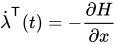
where the right-hand side is the vector of partial derivatives of the negative of the Hamiltonian with respect to the state variables.
Interpretation
editThe costate variables can be interpreted as Lagrange multipliers associated with the state equations. The state equations represent constraints of the minimization problem, and the costate variables represent the marginal cost of violating those constraints; in economic terms the costate variables are the shadow prices.[3][4]

Solution
editThe state equation is subject to an initial condition and is solved forwards in time. The costate equation must satisfy a transversality condition and is solved backwards in time, from the final time towards the beginning. For more details see Pontryagin's maximum principle.[5]
See also
editReferences
edit- ^ Kamien, Morton I.; Schwartz, Nancy L. (1991). Dynamic Optimization (Second ed.). London: North-Holland. pp. 126–27. ISBN 0-444-01609-0.
- ^ Luenberger, David G. (1969). Optimization by Vector Space Methods. New York: John Wiley & Sons. p. 263. ISBN 9780471181170.
- ^ Takayama, Akira (1985). Mathematical Economics. Cambridge University Press. p. 621. ISBN 9780521314985.
- ^ Léonard, Daniel (1987). "Co-state Variables Correctly Value Stocks at Each Instant : A Proof". Journal of Economic Dynamics and Control. 11 (1): 117–122. doi:10.1016/0165-1889(87)90027-3.
- ^ Ross, I. M. A Primer on Pontryagin's Principle in Optimal Control, Collegiate Publishers, 2009. ISBN 978-0-9843571-0-9.
