In mathematics, Milnor maps are named in honor of John Milnor, who introduced them to topology and algebraic geometry in his book Singular Points of Complex Hypersurfaces (Princeton University Press, 1968) and earlier lectures. The most studied Milnor maps are actually fibrations, and the phrase Milnor fibration is more commonly encountered in the mathematical literature. These were introduced to study isolated singularities by constructing numerical invariants related to the topology of a smooth deformation of the singular space.
Definition
editLet be a non-constant polynomial function of complex variables where the vanishing locus of
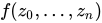


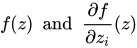
is only at the origin, meaning the associated variety is not smooth at the origin. Then, for (a sphere inside of radius ) the Milnor fibration[1]pg 68 associated to is defined as the map




- ,

which is a locally trivial smooth fibration for sufficiently small . Originally this was proven as a theorem by Milnor, but was later taken as the definition of a Milnor fibration. Note this is a well defined map since

- ,

where is the argument of a complex number.

Historical motivation
editOne of the original motivations for studying such maps was in the study of knots constructed by taking an -ball around a singular point of a plane curve, which is isomorphic to a real 4-dimensional ball, and looking at the knot inside the boundary, which is a 1-manifold inside of a 3-sphere. Since this concept could be generalized to hypersurfaces with isolated singularities, Milnor introduced the subject and proved his theorem.
In algebraic geometry
editAnother closed related notion in algebraic geometry is the Milnor fiber of an isolated hypersurface singularity. This has a similar setup, where a polynomial with having a singularity at the origin, but now the polynomial


is considered. Then, the algebraic Milnor fiber is taken as one of the polynomials .

Properties and Theorems
editParallelizability
editOne of the basic structure theorems about Milnor fibers is they are parallelizable manifolds[1]pg 75.
Homotopy type
editMilnor fibers are special because they have the homotopy type of a bouquet of spheres[1]pg 78. The number of these spheres is the Milnor number. In fact, the number of spheres can be computed using the formula
![{\displaystyle \mu (f)={\text{dim}}_{\mathbb {C} }{\frac {\mathbb {C} [[z_{0},\ldots ,z_{n}]]}{\operatorname {Jac} (f)}},}](https://wikimedia.org/api/rest_v1/media/math/render/svg/ce14c5e5e89ef127bbef95a52a32e20b0cda4289)
where the quotient ideal is the Jacobian ideal, defined by the partial derivatives . These spheres deformed to the algebraic Milnor fiber are the Vanishing cycles of the fibration[1]pg 83. Computing the eigenvalues of their monodromy is computationally challenging and requires advanced techniques such as b-functions[2]pg 23.

Milnor's fibration theorem
editMilnor's Fibration Theorem states that, for every such that the origin is a singular point of the hypersurface (in particular, for every non-constant square-free polynomial of two variables, the case of plane curves), then for sufficiently small,


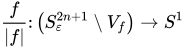
is a fibration. Each fiber is a non-compact differentiable manifold of real dimension . Note that the closure of each fiber is a compact manifold with boundary. Here the boundary corresponds to the intersection of with the -sphere (of sufficiently small radius) and therefore it is a real manifold of dimension . Furthermore, this compact manifold with boundary, which is known as the Milnor fiber (of the isolated singular point of at the origin), is diffeomorphic to the intersection of the closed -ball (bounded by the small -sphere) with the (non-singular) hypersurface where and is any sufficiently small non-zero complex number. This small piece of hypersurface is also called a Milnor fiber.


Milnor maps at other radii are not always fibrations, but they still have many interesting properties. For most (but not all) polynomials, the Milnor map at infinity (that is, at any sufficiently large radius) is again a fibration.
Examples
editThe Milnor map of at any radius is a fibration; this construction gives the trefoil knot its structure as a fibered knot.

See also
editReferences
edit- ^ a b c d Dimca, Alexandru (1992). Singularities and Topology of Hypersurfaces. New York, NY: Springer. ISBN 978-1-4612-4404-2. OCLC 852790417.
- ^ Budur, Nero. "Multiplier ideals, Milnor fibers, and other singularity invariants" (PDF). doi:10.1002/humu.22655. S2CID 221776902. Archived from the original (PDF) on 6 March 2019.
- Milnor, John W. (1968), Singular points of complex hypersurfaces, Annals of Mathematics Studies, No. 61. Princeton University Press, Princeton, NJ; University of Tokyo Press, Tokyo, ISBN 0-691-08065-8
