In mathematics, a differentiable manifold of dimension n is called parallelizable[1] if there exist smooth vector fields on the manifold, such that at every point of the tangent vectors provide a basis of the tangent space at . Equivalently, the tangent bundle is a trivial bundle,[2] so that the associated principal bundle of linear frames has a global section on

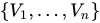



A particular choice of such a basis of vector fields on is called a parallelization (or an absolute parallelism) of .
Examples
edit- An example with is the circle: we can take V1 to be the unit tangent vector field, say pointing in the anti-clockwise direction. The torus of dimension is also parallelizable, as can be seen by expressing it as a cartesian product of circles. For example, take and construct a torus from a square of graph paper with opposite edges glued together, to get an idea of the two tangent directions at each point. More generally, every Lie group G is parallelizable, since a basis for the tangent space at the identity element can be moved around by the action of the translation group of G on G (every translation is a diffeomorphism and therefore these translations induce linear isomorphisms between tangent spaces of points in G).
- A classical problem was to determine which of the spheres Sn are parallelizable. The zero-dimensional case S0 is trivially parallelizable. The case S1 is the circle, which is parallelizable as has already been explained. The hairy ball theorem shows that S2 is not parallelizable. However S3 is parallelizable, since it is the Lie group SU(2). The only other parallelizable sphere is S7; this was proved in 1958, by Friedrich Hirzebruch, Michel Kervaire, and by Raoul Bott and John Milnor, in independent work. The parallelizable spheres correspond precisely to elements of unit norm in the normed division algebras of the real numbers, complex numbers, quaternions, and octonions, which allows one to construct a parallelism for each. Proving that other spheres are not parallelizable is more difficult, and requires algebraic topology.
- The product of parallelizable manifolds is parallelizable.
- Every orientable closed three-dimensional manifold is parallelizable.[3]


Remarks
edit- Any parallelizable manifold is orientable.
- The term framed manifold (occasionally rigged manifold) is most usually applied to an embedded manifold with a given trivialisation of the normal bundle, and also for an abstract (that is, non-embedded) manifold with a given stable trivialisation of the tangent bundle.
- A related notion is the concept of a π-manifold.[4] A smooth manifold is called a π-manifold if, when embedded in a high dimensional euclidean space, its normal bundle is trivial. In particular, every parallelizable manifold is a π-manifold.
See also
edit- Chart (topology)
- Differentiable manifold
- Frame bundle
- Kervaire invariant
- Orthonormal frame bundle
- Principal bundle
- Connection (mathematics)
- G-structure
Notes
edit- ^ Bishop, Richard L.; Goldberg, Samuel I. (1968), Tensor Analysis on Manifolds, New York: Macmillan, p. 160
- ^ Milnor, John W.; Stasheff, James D. (1974), Characteristic Classes, Annals of Mathematics Studies, vol. 76, Princeton University Press, p. 15, ISBN 0-691-08122-0
- ^ Benedetti, Riccardo; Lisca, Paolo (2019-07-23). "Framing 3-manifolds with bare hands". L'Enseignement Mathématique. 64 (3): 395–413. arXiv:1806.04991. doi:10.4171/LEM/64-3/4-9. ISSN 0013-8584. S2CID 119711633.
- ^ Milnor, John W. (1958), Differentiable manifolds which are homotopy spheres (PDF)
References
edit- Bishop, Richard L.; Goldberg, Samuel I. (1968), Tensor Analysis on Manifolds (First Dover 1980 ed.), The Macmillan Company, ISBN 0-486-64039-6
- Milnor, John W.; Stasheff, James D. (1974), Characteristic Classes, Princeton University Press
- Milnor, John W. (1958), Differentiable manifolds which are homotopy spheres (PDF), mimeographed notes
