^ David J.C. MacKay and Radford M. Neal, "Near Shannon Limit Performance of Low Density Parity Check Codes," Electronics Letters, July 1996
^R. M. Tanner, “A Recursive Approach to Low Complexity Codes,” IEEE Trans. Inform. Theory, Vol. IT-27, no. 5, pp. 399–431, Sep. 1981.
^F. R. Kschischang, B. J. Frey and H. A. Loeliger, “Factor Graphs and the Sum-Product Algorithm,” IEEE Trans. Info. Theory, Vol. 47, pp. 498–519, Feb. 2001.
^M. P. C. Fossorier, M. Mihaljevic, and H. Imai, “Reduced Complexity Iterative Decoding of Low-density Parity Check Codes Based on Belief Propagation,” IEEE Trans. Commun., vol. 47, no. 5, pp. 673–680, May, 1999.
^J. Chen, A. Dholakia, E. Eleftheriou, M. P. C. Fossorier, and X. Y. Hu, “Reduced-complexity Decoding of LDPC Codes,” IEEE Trans. Commun., vol. 53, no. 8, pp. 1288–1299, Aug. 2005.
Deciphered Linear B: the story of Michael Ventris (2002) Thames & Hudson ISBN 0500510776 Singh, Simon(英语:Simon Singh). The Code Book(英语:The Code Book). Anchor
description of PCM with links to information about subtypes of this format (for example Linear Pulse Code Modulation), and references to their specifications.
University Press. 2003: 9. ISBN 9780521642989. Because the Hamming code is a linear code, it can be written compactly in terms of matrices as follows. The
2011. Verbeke, G.; Mollenberghs, G. Linear Mixed Models for Longitudinal Data. Springer. 2013. Includes SAS code Centre for Multilevel Modelling (页面存档备份,存于互联网档案馆)
![{\displaystyle H=\left[{\begin{matrix}1&1&1&1&0&0&0&0&0&0\\0&0&0&0&1&1&1&1&0&0\\0&0&0&0&0&0&0&0&1&1\\0&0&0&0&0&0&0&0&0&0\\1&0&0&0&0&0&0&1&0&0\\0&1&0&0&1&0&0&0&0&0\\0&0&1&0&0&1&0&0&1&0\\0&0&0&1&0&0&1&0&0&1\end{matrix}}\quad \!{\begin{matrix}0&0&0&0&0&0\\0&0&0&0&0&0\\1&1&0&0&0&0\\0&0&1&1&1&1\\1&0&0&1&0&0\\0&1&0&0&1&0\\0&0&0&0&0&1\\0&0&1&0&0&0\end{matrix}}\right]}](https://wikimedia.org/api/rest_v1/media/math/render/svg/88da6407a65fc64efc2cc4ee5edebc253be7b61a)







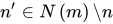
![{\displaystyle \Lambda _{m\to n}\left(u_{n}\right)=2\tanh ^{-1}\left\{\prod _{n'\in N\left(m\right)\backslash n}\tanh \left[{\frac {\lambda _{n'\to m}\left(u_{n'}\right)}{2}}\right]\right\}}](https://wikimedia.org/api/rest_v1/media/math/render/svg/aa1e896866cdfa2543dbe341e15fa724e50e6896)