In the field of mathematics known as complex analysis, the indicator function of an entire function indicates the rate of growth of the function in different directions.
Definition
editLet us consider an entire function . Supposing, that its growth order is , the indicator function of is defined to be[1][2]


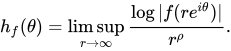
The indicator function can be also defined for functions which are not entire but analytic inside an angle .

Basic properties
editBy the very definition of the indicator function, we have that the indicator of the product of two functions does not exceed the sum of the indicators:[2]: 51–52

Similarly, the indicator of the sum of two functions does not exceed the larger of the two indicators:

Examples
editElementary calculations show that, if , then . Thus,[2]: 52
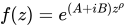


In particular,

Since the complex sine and cosine functions are expressible in terms of the exponential, it follows from the above result that

Another easily deducible indicator function is that of the reciprocal Gamma function. However, this function is of infinite type (and of order ), therefore one needs to define the indicator function to be


Stirling's approximation of the Gamma function then yields, that

Another example is that of the Mittag-Leffler function . This function is of order , and[3]: 50


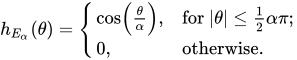
The indicator of the Barnes G-function can be calculated easily from its asymptotic expression (which roughly says that ):


Further properties of the indicator
editThose indicator functions which are of the form are called -trigonometrically convex ( and are real constants). If , we simply say, that is trigonometrically convex.




Such indicators have some special properties. For example, the following statements are all true for an indicator function that is trigonometrically convex at least on an interval :[1]: 55–57 [2]: 54–61

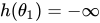
- If for a , then everywhere in .
- If is bounded on , then it is continuous on this interval. Moreover, satisfies a Lipschitz condition on .
- If is bounded on , then it has both left-hand-side and right-hand-side derivative at every point in the interval . Moreover, the left-hand-side derivative is not greater than the right-hand-side derivative. It also holds true, that the right-hand-side derivative is continuous from the right, while the left-hand-side derivative is continuous from the left.
- If is bounded on , then it has a derivative at all points, except possibly on a countable set.
- If is -trigonometrically convex on , then , whenever .


![{\displaystyle [\alpha ,\beta ]}](https://wikimedia.org/api/rest_v1/media/math/render/svg/878fce9eb3ba664f0ad4d025f04214fa85ee9583)


Notes
edit- ^ a b Levin, B. Ya. (1996). Lectures on Entire Functions. Amer. Math. Soc. ISBN 0821802828.
- ^ a b c d Levin, B. Ya. (1964). Distribution of Zeros of Entire Functions. Amer. Math. Soc. ISBN 978-0-8218-4505-9.
{{cite book}}: ISBN / Date incompatibility (help) - ^ Cartwright, M. L. (1962). Integral Functions. Cambridge Univ. Press. ISBN 052104586X.
{{cite book}}: ISBN / Date incompatibility (help)
References
edit- Boas, R. P. (1954). Entire Functions. Academic Press. ISBN 0121081508.
{{cite book}}: ISBN / Date incompatibility (help) - Volkovyskii, L. I.; Lunts, G. L.; Aramanovich, I. G. (2011). A collection of problems on complex analysis. Dover Publications. ISBN 978-0486669137.
- Markushevich, A. I.; Silverman, R. A. (1965). Theory of functions of a complex variable, Vol. II. Prentice-Hall Inc. ASIN B003ZWIKFC.
