The IDE64 interface cartridge is an expansion port device for connecting ATA(PI) devices to the C64 or C128 computers.
Hardware
editThere were several different versions[1] of this cartridge over the years. The interface was designed by Tomas Pribyl and Jan Vorlicek in 1994. As of 2023[2] Josef Soucek was the maintainer of the design (involved in the project at least since 2006[3]).
- IDE64 v1.1 – In 1997 the first public version of the cartridge appeared. The logic was fitted into 2 ispLSIs, the operating system was burned into a 32 kB EPROM, and there was 16 kB of RAM storage for buffers. There was a DS1302 real-time clock included which could keep the settings and hold the time backed by a battery. Beside the parallel ATA connector also an expansion port pass through was included to allow attaching of other cartridges.
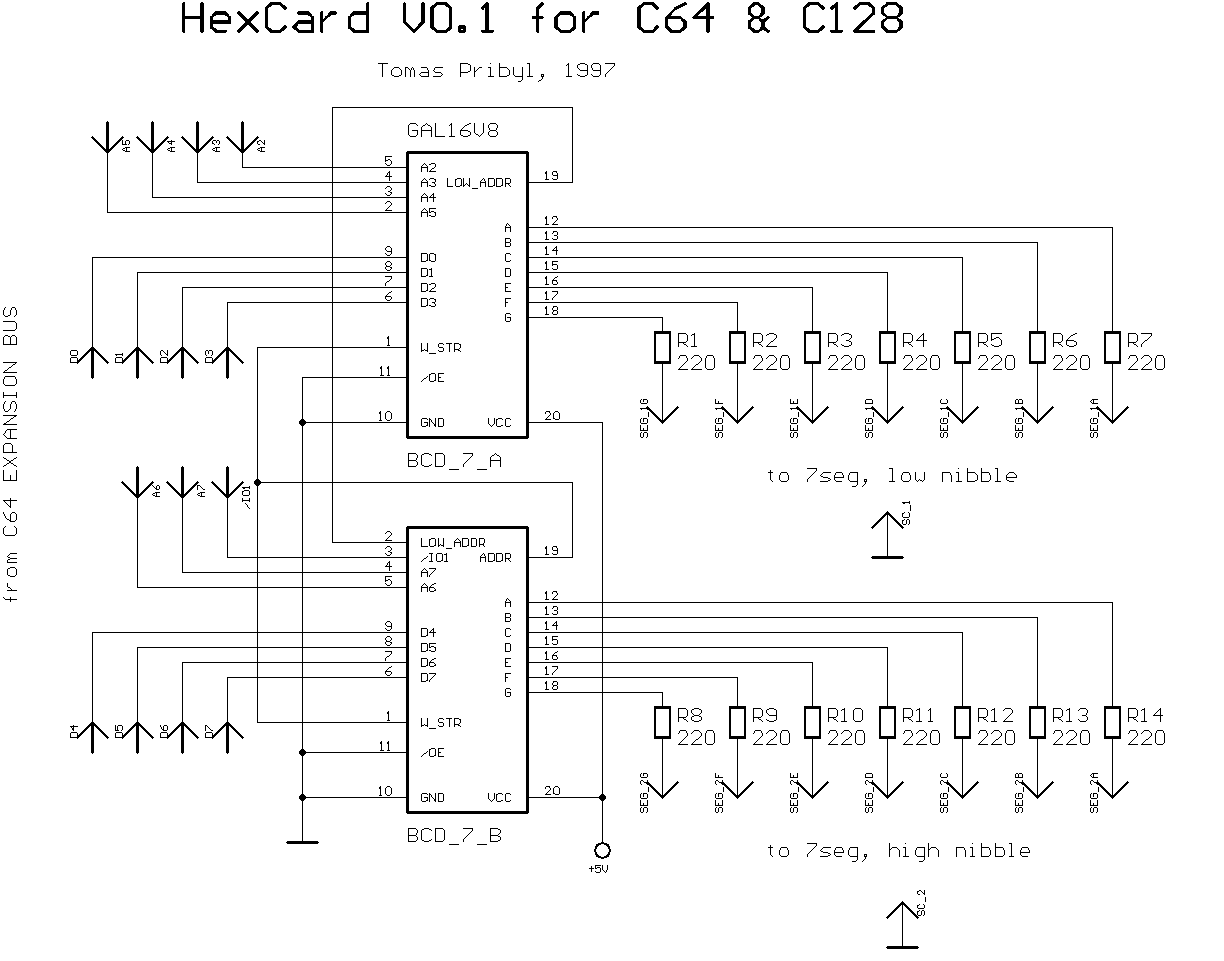
- IDE64 v2.1 – Around 1999 the first "modern" version of the cartridge came out, merging the logic into one big ispLSI PLD. Also the EPROM was upgraded to a 64 kB EEPROM to allow operating system upgrades without special equipment. The RAM was extended to hold 28 kB of buffers and internal variables. There was a new connector on board, called ShortBus. It was meant for hardware expansions like LCD,[4] 7-segment display,[5] but later also more sophisticated expansions appeared. This was also the first version to include SuperCPU compatibility.
- IDE64 v3.1 –In 2001 a redesigned version of the 2.1 cartridge was made, this version drops the expansion port pass-through.
- IDE64 v3.4 –CompactFlash cards became popular, so the cartridge was redesigned in 2004 to include a CF socket. This allowed a mobile and small storage possibility for the C64, without additional devices and power supplies.
- IDE64 v3.4+ – In 2005, with a small hardware change, the EEPROM was upgraded to 128 kB, which allowed to hold two versions of the operating system for both a standard C64 and SuperCPU. This was selectable with a small switch, and solved the reflashing problem for those with SuperCPU equipped systems.
- IDE64 v4.1 – The pre-release happened in 2008 August,[6] but it was not available until 2009 March. The hardware was redesigned to use surface-mounted parts and a more up-to-date ispMACH CPLD, which resulted in a much shorter board. A USB serial FIFO chip was added for fast PCLink connections, and an Amiga clock-port for connecting additional devices. The card slot on this version is separated from the parallel ATA port, and offers wider compatibility with CF cards. The I/O interface was changed to support 128 kB operating system and was tweaked for slightly faster data transfer speeds.
ShortBus expansions
edit- ETH64 – A LAN91C96 chip based Ethernet card. It is supported by Contiki, Wings and maybe some other software. It can also be used for PCLink connection.
- DUART – This is a XR68C681 based dual RS-232 card featuring, mostly used for PCLink connection. It is supported by Contiki, Wings, Novaterm 9.6 and maybe some other software.
- DigiMAX – It is a MAX506 based 4 channel 8-bit digital-to-analog converter card, can be used as "sound card", as the output comes out on two jack plugs. This card is supported by Modplay, Wings and maybe some other programs.
- ETFE – This is a CS8900 based Ethernet card, just like the popular RR-Net, but the v1.1 version works only in TFE compatible mode. It can be used for PCLink, has a Contiki driver, and work with software designed for the original TFE card. For the next version (v1.2) a jumper is promised to simulate a RR-Net card.
References
editThis article includes a list of general references, but it lacks sufficient corresponding inline citations. (April 2009) |