A real function is locally constant (that is, constant in at least one neighbourhood) of a point in the interior of its domain if and only if the function is flat and analytic at that point.
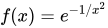
An example of a function that is flat only at an isolated point is such that and that for all , implies ; the function is flat only at .
Since is not analytic at , the extension of to is not holomorphic at , since for complex functions, holomorphicity at a point implies analyticity at that point.
Examples of construction of non-trivial flat functions
edit
By a non-trivial flat function, what is meant is a function that, at least at one point in the interior of its domain, is flat but not locally constant.
Construction of univariate flat functions
edit
Let be a positive real number and let (where is a neighbourhood of a point ) be such that and that for all , implies
Then is flat at .
Construction of multivariate flat functions
edit
Let be flat at , and let (where , is an -dimensional real coordinate vector, and is a neighbourhood of ) be such that for all ,, where for all , denotes the Euclidean norm of .
Then is flat at .
A necessary condition for flatness and local non-constancy
edit
Let for some and let be flat at a point in the interior of . Also let it be the case that for every neighbourhood of , there exists an such that , that is, that is not locally constant at . Then is non-analytic at .
Proof
edit
Assume the contrary, that is, that is analytic at . Since is flat at , the Taylor series of at is constant and equal to . Since it is assumed that is analytic at , then there exists a neighbourhood of such that for all , . This contradicts that for every neighbourhood of , there exists an such that . Hence, by contradiction, is non-analytic at .
A sufficient condition for flatness
edit
Let for some and let be infinitely differentiable at a point in the interior of . Also let it be the case that for every neighbourhood of , there exists an such that is flat at . Then is flat at .
Proof
edit
Assume the contrary, that is, that is not flat at . Then there exists a such that a -th partial derivative of (call it ) is non-zero at , that is, for some such that . Since is infinitely differentiable at , then is continuous at . Since , then . Then there exists a neighbourhood of such that for all , , which means , or, in other words, lies in the open interval . Since , , so , which means that there exists a such that a -th partial derivative of is non-zero at . This contradicts that is flat at at least one point in every neighbourhood of . Hence, by contradiction, is flat at .
The above results can be used to show that a bump function is flat and non-analytic at each boundary point of the closure of its support.
Let be an interval with non-empty interior, with supremum, and containing ; and let be an interval with non-empty interior, with infimum, and containing .
In the following, continuity, one-sided continuity, one-sided limits, differentiability and smoothness of a real coordinate vector-valued function are respectively given by continuity, one-sided continuity, one-sided limits, differentiability and smoothness of the function in each coordinate.
Let . Let be continuously differentiable at every point in the interior of , left-continuous at and have the left-hand limit of its derivatives of all orders be finite at ; also let for all . Let be continuously differentiable at every point in the interior of , right-continuous at and have the right-hand limit of its derivatives of all orders be finite at ; also let for all .
Let curves and be the images of the domains of and , respectively. Both and inhabit .
A smooth interpolation between and , between the points and , is the image of the domain of a function such that the left-hand limit of at is , the right-hand limit of at is , and for all , the left-hand limit of the -th derivative of at is equal to the right-hand limit of the -th derivative of at , and the right-hand limit of the -th derivative of at is equal to the left-hand limit of the -th derivative of at . A smooth interpolation between and is defined to have continuity (geometric continuity of all orders) with and .
Let be such that: for all , ; for all , ; and for all , .
If and are straight line segments, is necessarily flat at and . If and are non-collinear straight line segments, there necessarily exists a point in at which is non-analytic. If the end segments of the smooth interpolation are not straight-segment extensions of line segments and , is necessarily non-analytic at and .
Glaister, P. (December 1991), A Flat Function with Some Interesting Properties and an Application, The Mathematical Gazette, Vol. 75, No. 474, pp. 438–440, JSTOR3618627
Antarctica Flat River (disambiguation), in the United States and Canada Flat function, a real function where all derivatives at a point are 0 Flat (geometry)
situations Flatness (systems theory), a property of nonlinear dynamic systems Spectral flatness Flat function in mathematical analysis Flat intonation Flat module
Rosenbrock's valley or Rosenbrock's banana function. The global minimum is inside a long, narrow, parabolic-shaped flat valley. To find the valley is trivial
Flat bones are bones whose principal function is either extensive protection or the provision of broad surfaces for muscular attachment. These bones are
processing and statistics, a window function (also known as an apodization function or tapering function) is a mathematical function that is zero-valued outside
.jpeg)




![{\displaystyle [s_{1},s_{2}]}](https://wikimedia.org/api/rest_v1/media/math/render/svg/0f8fca3c95bdf474e9ff57f8c11496d4d3432e3b)

