
In the mathematical theory of functions of one or more complex variables, and also in complex algebraic geometry, a biholomorphism or biholomorphic function is a bijective holomorphic function whose inverse is also holomorphic.
Formal definition
editFormally, a biholomorphic function is a function defined on an open subset U of the -dimensional complex space Cn with values in Cn which is holomorphic and one-to-one, such that its image is an open set in Cn and the inverse is also holomorphic. More generally, U and V can be complex manifolds. As in the case of functions of a single complex variable, a sufficient condition for a holomorphic map to be biholomorphic onto its image is that the map is injective, in which case the inverse is also holomorphic.[1]


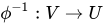
If there exists a biholomorphism , we say that U and V are biholomorphically equivalent or that they are biholomorphic.

Riemann mapping theorem and generalizations
editIf every simply connected open set other than the whole complex plane is biholomorphic to the unit disc (this is the Riemann mapping theorem). The situation is very different in higher dimensions. For example, open unit balls and open unit polydiscs are not biholomorphically equivalent for In fact, there does not exist even a proper holomorphic function from one to the other.


Alternative definitions
editIn the case of maps f : U → C defined on an open subset U of the complex plane C, some authors[2] define a conformal map to be an injective map with nonzero derivative i.e., f’(z)≠ 0 for every z in U. According to this definition, a map f : U → C is conformal if and only if f: U → f(U) is biholomorphic. Notice that per definition of biholomorphisms, nothing is assumed about their derivatives, so, this equivalence contains the claim that a homeomorphism that is complex differentiable must actually have nonzero derivative everywhere. Other authors[3] define a conformal map as one with nonzero derivative, but without requiring that the map be injective. According to this weaker definition, a conformal map need not be biholomorphic, even though it is locally biholomorphic, for example, by the inverse function theorem. For example, if f: U → U is defined by f(z) = z2 with U = C–{0}, then f is conformal on U, since its derivative f’(z) = 2z ≠ 0, but it is not biholomorphic, since it is 2-1.
References
edit- ^ Gunning, Robert Clifford (1990). Introduction to holomorphic functions of several variables. Wadsworth & Brooks/Cole mathematics series (Rev. version and complete rewriting of : Analytic functions of several complex variables ed.). Belmont (Calif.): Wadsworth. Theorem I.11 or Corollary E.10. ISBN 978-0-534-13308-5.
- ^ Freitag, E.; Busam, Rolf (2009). Complex analysis. Universitext (2nd ed., [2nd English ed.] ed.). Berlin: Springer. Definition IV.4.1. ISBN 978-3-540-93982-5.
- ^ Conway, John B. (1986). Functions of one complex variable. Functions of one complex variable (2nd ed., 4th corr. print ed.). New York Berlin Paris [etc.]: Springer. ISBN 978-0-387-90328-6.
Bibliography
edit- Conway, John B. (1978). Functions of One Complex Variable. Springer-Verlag. ISBN 3-540-90328-3.
- D'Angelo, John P. (1993). Several Complex Variables and the Geometry of Real Hypersurfaces. CRC Press. ISBN 0-8493-8272-6.
- Freitag, Eberhard; Busam, Rolf (2009). Complex Analysis. Springer-Verlag. ISBN 978-3-540-93982-5.
- Gunning, Robert C. (1990). Introduction to Holomorphic Functions of Several Variables, Vol. II. Wadsworth. ISBN 0-534-13309-6.
- Krantz, Steven G. (2002). Function Theory of Several Complex Variables. American Mathematical Society. ISBN 0-8218-2724-3.
This article incorporates material from biholomorphically equivalent on PlanetMath, which is licensed under the Creative Commons Attribution/Share-Alike License.
