In computational fluid dynamics (CFD), the SIMPLE algorithm is a widely used numerical procedure to solve the Navier–Stokes equations. SIMPLE is an acronym for Semi-Implicit Method for Pressure Linked Equations.
The SIMPLE algorithm was developed by Prof. Brian Spalding and his student Suhas Patankar at Imperial College London in the early 1970s. Since then it has been extensively used by many researchers to solve different kinds of fluid flow and heat transfer problems.[1]
Many popular books on computational fluid dynamics discuss the SIMPLE algorithm in detail.[2][3] A modified variant is the SIMPLER algorithm (SIMPLE Revised), that was introduced by Patankar in 1979.[4]
Algorithm
editThe algorithm is iterative. The basic steps in the solution update are as follows:
- Set the boundary conditions.
- Compute the gradients of velocity and pressure.
- Solve the discretized momentum equation to compute the intermediate velocity field.
- Compute the uncorrected mass fluxes at faces.
- Solve the pressure correction equation to produce cell values of the pressure correction.
- Update the pressure field: where urf is the under-relaxation factor for pressure.
- Update the boundary pressure corrections .
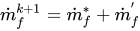
- Correct the face mass fluxes:
- Correct the cell velocities: ; where is the gradient of the pressure corrections, is the vector of central coefficients for the discretized linear system representing the velocity equation and Vol is the cell volume.
- Update density due to pressure changes.




See also
editReferences
edit- ^ Mangani, L.; Bianchini, C. (2007). Heat transfer applications in turbomachinery (PDF). Proceedings of the OpenFOAM International Conference 2007. Retrieved 2016-03-16.
- ^ Patankar, S. V. (1980). Numerical Heat Transfer and Fluid Flow. Taylor & Francis. ISBN 978-0-89116-522-4.
- ^ Ferziger, J. H.; Peric, M. (2001). Computational Methods for Fluid Dynamics. Springer-Verlag. ISBN 978-3-540-42074-3.
- ^ Tannehill, J. C.; Anderson, D. A.; Pletcher, R. H. (1997). Computational Fluid Mechanics and Heat Transfer. Taylor & Francis. ISBN 9781560320463.
