In mathematics, the Schottky problem, named after Friedrich Schottky, is a classical question of algebraic geometry, asking for a characterisation of Jacobian varieties amongst abelian varieties.
Geometric formulation
editMore precisely, one should consider algebraic curves of a given genus , and their Jacobians . There is a moduli space of such curves, and a moduli space of abelian varieties, , of dimension , which are principally polarized. There is a morphism



which on points (geometric points, to be more accurate) takes isomorphism class to . The content of Torelli's theorem is that is injective (again, on points). The Schottky problem asks for a description of the image of , denoted .[1]
![{\displaystyle [C]}](https://wikimedia.org/api/rest_v1/media/math/render/svg/798adf333080234dd9da202633a4d63c4ea091aa)
![{\displaystyle [\operatorname {Jac} (C)]}](https://wikimedia.org/api/rest_v1/media/math/render/svg/e0213e384fd86a87fba8bc45cd99f5d5d9c63c5e)

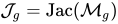
The dimension of is ,[2] for , while the dimension of is g(g + 1)/2. This means that the dimensions are the same (0, 1, 3, 6) for g = 0, 1, 2, 3. Therefore is the first case where the dimensions change, and this was studied by F. Schottky in the 1880s. Schottky applied the theta constants, which are modular forms for the Siegel upper half-space, to define the Schottky locus in . A more precise form of the question is to determine whether the image of essentially coincides with the Schottky locus (in other words, whether it is Zariski dense there).


Dimension 1 case
editAll elliptic curves are the Jacobian of themselves, hence the moduli stack of elliptic curves is a model for .


Dimensions 2 and 3
editIn the case of Abelian surfaces, there are two types of Abelian varieties:[3] the Jacobian of a genus 2 curve, or the product of Jacobians of elliptic curves. This means the moduli spaces

embed into . There is a similar description for dimension 3 since an Abelian variety can be the product of Jacobians.

Period lattice formulation
editIf one describes the moduli space in intuitive terms, as the parameters on which an abelian variety depends, then the Schottky problem asks simply what condition on the parameters implies that the abelian variety comes from a curve's Jacobian. The classical case, over the complex number field, has received most of the attention, and then an abelian variety A is simply a complex torus of a particular type, arising from a lattice in Cg. In relatively concrete terms, it is being asked which lattices are the period lattices of compact Riemann surfaces.
Riemann's matrix formulation
editNote that a Riemann matrix is quite different from any Riemann tensor
One of the major achievements of Bernhard Riemann was his theory of complex tori and theta functions. Using the Riemann theta function, necessary and sufficient conditions on a lattice were written down by Riemann for a lattice in Cg to have the corresponding torus embed into complex projective space. (The interpretation may have come later, with Solomon Lefschetz, but Riemann's theory was definitive.) The data is what is now called a Riemann matrix. Therefore the complex Schottky problem becomes the question of characterising the period matrices of compact Riemann surfaces of genus g, formed by integrating a basis for the abelian integrals round a basis for the first homology group, amongst all Riemann matrices. It was solved by Takahiro Shiota in 1986.[4]
Geometry of the problem
editThere are a number of geometric approaches, and the question has also been shown to implicate the Kadomtsev–Petviashvili equation, related to soliton theory.
See also
editReferences
edit- ^ Grushevsky, Samuel (2010-09-29). "The Schottky Problem". arXiv:1009.0369 [math.AG].
- ^ follows from elementary Deformation Theory
- ^ Oort, F. (1973). Principally polarized abelian varieties of dimension two or three are jacobian varieties (PDF). Aarhus Universitet. Matematisk Institut. OCLC 897746916. Archived from the original on 9 Jun 2020.
- ^ Shiota, Takahiro (1986). "Characterization of Jacobian varieties in terms of soliton equations". Inventiones Mathematicae. 83 (2): 333–382. Bibcode:1986InMat..83..333S. doi:10.1007/BF01388967. S2CID 120739493.
- Beauville, Arnaud (1987), "Le problème de Schottky et la conjecture de Novikov", Astérisque, Séminaire Bourbaki (152): 101–112, ISSN 0303-1179, MR 0936851
- Debarre, Olivier (1995), "The Schottky problem: an update", Current topics in complex algebraic geometry (Berkeley, CA, 1992/93), Math. Sci. Res. Inst. Publ., vol. 28, Cambridge University Press, pp. 57–64, MR 1397058
- Geer, G. van der (2001) [1994], "Schottky problem", Encyclopedia of Mathematics, EMS Press
- Grushevsky, Samuel (2011), "The Schottky problem" (PDF), in Caporaso, Lucia; McKernan, James; Popa, Mihnea; et al. (eds.), Current Developments in Algebraic Geometry, MSRI Publications, vol. 59, ISBN 978-0-521-76825-2
