


The rusty bolt effect is a form of radio interference due to interactions of the radio waves with dirty connections or corroded parts.[1] It is more properly known as passive intermodulation,[1] and can result from a variety of different causes such as ferromagnetic conduction metals,[2] or nonlinear microwave absorbers and loads.[3] Corroded materials on antennas, waveguides, or even structural elements, can act as one or more diodes. (Crystal sets, early radio receivers, used the semiconductor properties of natural galena to demodulate the radio signal, and copper oxide was used in power rectifiers.) Galvanised fasteners and sheet roofing develop a coating of zinc oxide, a semiconductor commonly used for transient voltage suppression. This gives rise to undesired interference, including the generation of harmonics or intermodulation.[4] Rusty objects that should not be in the signal-path, including antenna structures, can also reradiate radio signals with harmonics and other unwanted signals.[5] As with all out-of-band noise, these spurious emissions can interfere with receivers.
This effect can cause radiated signals out of the desired band, even if the signal into a passive antenna is carefully band-limited.[6]
Mathematics associated with the rusty bolt
editThe transfer characteristic of an object can be represented as a power series:
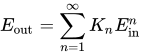
Or, taking only the first few terms (which are most relevant),

For an ideal perfect linear object K2, K3, K4, K5, etc. are all zero. A good connection approximates this ideal case with sufficiently small values.
For a 'rusty bolt' (or an intentionally designed frequency mixer stage), K2, K3, K4, K5, etc. are not all zero. These higher-order terms result in generation of harmonics.
The following analysis applies the power series representation to an input sine-wave.
Harmonic generation
editIf the incoming signal is a sine wave {Ein sin(ωt)}, (and taking only first-order terms), then the output can be written:

Clearly, the harmonic terms will be worse at high input signal amplitudes, as they increase exponentially with the amplitude of Ein.
Mixing product generation
editSecond order terms
editTo understand the generation of nonharmonic terms (frequency mixing), a more complete formulation must be used, including higher-order terms. These terms, if significant, give rise to intermodulation distortion.
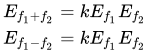
Third order terms
edit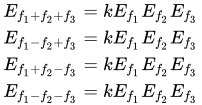
Hence the second-order, third-order, and higher-order mixing products can be greatly reduced by lowering the intensity of the original signals (f1, f2, f3, f4, …, fn)
References
edit- ^ a b Lui, P.L., Passive intermodulation interference in communication systems, IEEE Electronics & Communication Engineering Journal, Vol. 2, No. 3, pp.109-118, June 1990. Available online.
- ^ Henrie, J., Christianson, A. and Chappell, W. Engineered passive nonlinearities for broadband passive intermodulation distortion mitigation, Microwave and Wireless Components Letters, Vol. 19, pp.614-616, 2009. Available online.
- ^ Christianson, A. and Chappell, W. J. Measurement of ultra low passive intermodulation with ability to separate current/voltage induced nonlinearities, in IEEE Microwave Theory and Techniques Society International Microwave Symposium, Boston, Massachusetts, 2009, pp. 1301-1304. Available online.
- ^ "Preventing intermodulation". Retrieved 2011-02-13.
- ^ Lui, P.L.; Rawlins, A.D., The field measurement of passive intermodulation products. Fifth International Conference on Mobile Radio and Personal Communications, 1989. pp.199-203, 11-14 December 1989. Available online.
- ^ Johannessen, R.; Gale, S.J.; Asbury, M.J.A., Potential interference sources to GPS and solutions appropriate for applications to civil aviation. IEEE Aerospace and Electronic Systems Magazine, Vol. 5, No. 1, pp.3-9, January 1990 Available online.
