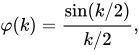
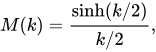
The rectangular function (also known as the rectangle function, rect function, Pi function, Heaviside Pi function,[1]gate function, unit pulse, or the normalized boxcar function) is defined as[2]
Alternative definitions of the function define to be 0,[3] 1,[4][5] or undefined. The area under the curve does not change for the different definitions of the functions at .
The rectangular function can be used as the basis for a rectangular wave.
The unit Rectangular function (in which ) along with the piecewise definedsplines that result from successive convolutions of the Rectangular function with itself.
A convolution of the discontinuous rectangular function with itself results in the triangular function, which is a continuous function:
Self convolution of the rectangular function applied twice yields a continuous and differentiably continuous parabolic spline:
A self convolution of the rectangular function applied three times yields a continuous, and a second order differentiably continuous cubic spline:
A self convolution of the rectangular function applied four times yields a continuous, and a third order differentiably continuous 4th order spline:
Since the Fourier transform of the rectangular function is the Sinc function, the convolution theorem implies that the Fourier transform of pulses resulting from successive convolutions of the rectangular function with itself is simply the Sinc function to the order of the number of times that the convolution function was applied + 1 (i.e., the Fourier transform of the triangular function is Sinc2, the Fourier transform of the parabolic spline resulting from two successive convolutions of the rectangular function with itself is Sinc3, etc.)
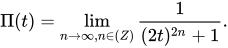
The pulse function may also be expressed as a limit of a rational function:
Dirac delta function
edit
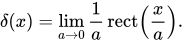
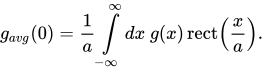
The rectangle function can be used to represent the Dirac delta function.[12] Specifically,For a function , its average over the width around 0 in the function domain is calculated as,
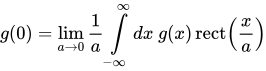
To obtain , the following limit is applied,
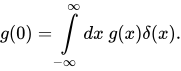
and this can be written in terms of the Dirac delta function as,
The Fourier transform of the Dirac delta function is
where the sinc function here is the normalized sinc function. Because the first zero of the sinc function is at and goes to infinity, the Fourier transform of is
means that the frequency spectrum of the Dirac delta function is infinitely broad. As a pulse is shorten in time, it is larger in spectrum.
probability theory and statistics, the continuous uniform distributions or rectangular distributions are a family of symmetric probability distributions. Such
diffraction from rectangular vs. circular apertures, which can be visualized in terms of the product of two sinc functions vs. an Airy function, respectively
everywhere and hence an entire function. The normalized sinc function is the Fourier transform of the rectangular function with no scaling. It is used in
system. The rectangular function, the normalized boxcar function, is used to model a unit pulse. The integer part function is not a step function according
Equivalently, it may be defined as the convolution of two identical unit rectangular functions: tri ( x ) = rect ( x ) ∗ rect ( x ) = ∫ − ∞ ∞ rect ( x
brackets Negative number Rectangular function Sign function Sine integral Step response Weisstein, Eric W. "Heaviside Step Function". MathWorld. Bracewell
The Huber loss is the convolution of the absolute value function with the rectangular function, scaled and translated. Thus it "smoothens out" the former's
response is a sinc function and whose frequency response is rectangular, or to a sinc-in-frequency filter whose impulse response is rectangular and whose frequency





.svg)