This article relies largely or entirely on a single source. (March 2026) |
In measure theory, a radonifying operator (ultimately named after Johann Radon) between measurable spaces is one that takes a cylinder set measure (CSM) on the first space to a true measure on the second space. It acquired its name because the pushforward measure on the second space was historically thought of as a Radon measure.
Definition
editGiven two separable Banach spaces and , a CSM on and a continuous linear map , we say that is radonifying if the push forward CSM (see below) on "is" a measure, i.e. there is a measure on such that



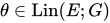




for each , where is the usual push forward of the measure by the linear map .[1]


Push forward of a CSM
editBecause the definition of a CSM on requires that the maps in be surjective, the definition of the push forward for a CSM requires careful attention. The CSM

is defined by

if the composition is surjective. If is not surjective, let be the image of , let be the inclusion map, and define



- ,

where (so ) is such that .



See also
edit- Abstract Wiener space – Mathematical construction relating to infinite-dimensional spaces
- Classical Wiener space – Space of stochastic processes
- Sazonov's theorem
References
edit- ^ van Neerven, Jan. "-randonifying Operators - A Survey" (PDF). Australian National University. Retrieved 8 Mar 2026.

