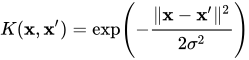
Since the value of the RBF kernel decreases with distance and ranges between zero (in the infinite-distance limit) and one (when x = x'), it has a ready interpretation as a similarity measure.[2]
The feature space of the kernel has an infinite number of dimensions; for , its expansion using the multinomial theorem is:[3]
Because support vector machines and other models employing the kernel trick do not scale well to large numbers of training samples or large numbers of features in the input space, several approximations to the RBF kernel (and similar kernels) have been introduced.[4]
Typically, these take the form of a function z that maps a single vector to a vector of higher dimensionality, approximating the kernel:
where is the implicit mapping embedded in the RBF kernel.
One way to construct such a z is to randomly sample from the Fourier transformation of the kernel[5]where are independent samples from the normal distribution .
Theorem:
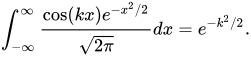
Proof: It suffices to prove the case of . Use the trigonometric identity , the spherical symmetry of Gaussian distribution, then evaluate the integral
In mathematics a radial basis function (RBF) is a real-valued function φ {\textstyle \varphi } whose value depends only on the distance between the input
mathematical modeling, a radial basis function network is an artificial neural network that uses radial basis functions as activation functions. The output of the
In functional analysis, a reproducing kernel Hilbert space (RKHS) is a Hilbert space of functions in which point evaluation is a continuous linear functional
feature matrices of size O ( D N ) {\textstyle O(DN)} . The radial basis function (RBF) kernel on two samples x i , x j ∈ R d {\displaystyle x_{i},x_{j}\in
Radial basis function (RBF) interpolation is an advanced method in approximation theory for constructing high-order accurate interpolants of unstructured
with kernel methods to cluster the patterns in the feature space. Bell-shaped function Cauchy distribution Normal distribution Radial basis function kernel





![{\displaystyle {\begin{alignedat}{2}\exp \left(-{\frac {1}{2}}\|\mathbf {x} -\mathbf {x'} \|^{2}\right)&=\exp \left({\frac {2}{2}}\mathbf {x} ^{\top }\mathbf {x'} -{\frac {1}{2}}\|\mathbf {x} \|^{2}-{\frac {1}{2}}\|\mathbf {x'} \|^{2}\right)\\[5pt]&=\exp \left(\mathbf {x} ^{\top }\mathbf {x'} \right)\exp \left(-{\frac {1}{2}}\|\mathbf {x} \|^{2}\right)\exp \left(-{\frac {1}{2}}\|\mathbf {x'} \|^{2}\right)\\[5pt]&=\sum _{j=0}^{\infty }{\frac {(\mathbf {x} ^{\top }\mathbf {x'} )^{j}}{j!}}\exp \left(-{\frac {1}{2}}\|\mathbf {x} \|^{2}\right)\exp \left(-{\frac {1}{2}}\|\mathbf {x'} \|^{2}\right)\\[5pt]&=\sum _{j=0}^{\infty }\quad \sum _{n_{1}+n_{2}+\dots +n_{k}=j}\exp \left(-{\frac {1}{2}}\|\mathbf {x} \|^{2}\right){\frac {x_{1}^{n_{1}}\cdots x_{k}^{n_{k}}}{\sqrt {n_{1}!\cdots n_{k}!}}}\exp \left(-{\frac {1}{2}}\|\mathbf {x'} \|^{2}\right){\frac {{x'}_{1}^{n_{1}}\cdots {x'}_{k}^{n_{k}}}{\sqrt {n_{1}!\cdots n_{k}!}}}\\[5pt]&=\langle \varphi (\mathbf {x} ),\varphi (\mathbf {x'} )\rangle \end{alignedat}}}](https://wikimedia.org/api/rest_v1/media/math/render/svg/c42c51e11b675698e01290de18306bcb7acc613f)





![{\displaystyle \varphi (x)={\frac {1}{\sqrt {D}}}[\cos \langle w_{1},x\rangle ,\sin \langle w_{1},x\rangle ,\ldots ,\cos \langle w_{D},x\rangle ,\sin \langle w_{D},x\rangle ]^{T}}](https://wikimedia.org/api/rest_v1/media/math/render/svg/1ebebe5193c52efc25a749492cf0269cd44e7f0d)


![{\displaystyle \operatorname {E} [\langle \varphi (x),\varphi (y)\rangle ]=e^{\|x-y\|^{2}/(2\sigma ^{2})}.}](https://wikimedia.org/api/rest_v1/media/math/render/svg/e2cc6c1d5eada384ef6b1f2a462dfa2089921bfb)


![{\displaystyle \operatorname {Var} [\langle \varphi (x),\varphi (y)\rangle ]=O(D^{-1})}](https://wikimedia.org/api/rest_v1/media/math/render/svg/e8ab3082dbba4fa920eee2c462249655c7908dc0)
