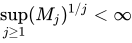
In mathematics, a quasi-analytic class of functions is a generalization of the class of real analytic functions based upon the following fact: If f is an analytic function on an interval [a,b] ⊂ R, and at some point f and all of its derivatives are zero, then f is identically zero on all of [a,b]. Quasi-analytic classes are broader classes of functions for which this statement still holds true.
Definitions
editLet be a sequence of positive real numbers. Then the Denjoy–Carleman class of functions CM([a,b]) is defined to be those f ∈ C∞([a,b]) which satisfy
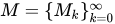
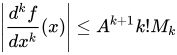
for all x ∈ [a,b], some constant A, and all non-negative integers k. If Mk = 1 this is exactly the class of real analytic functions on [a,b].
The class CM([a,b]) is said to be quasi-analytic if whenever f ∈ CM([a,b]) and

for some point x ∈ [a,b] and all k, then f is identically equal to zero.
A function f is called a quasi-analytic function if f is in some quasi-analytic class.
Quasi-analytic functions of several variables
editFor a function and multi-indexes , denote , and



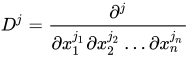

and

Then is called quasi-analytic on the open set if for every compact there is a constant such that



for all multi-indexes and all points .


The Denjoy–Carleman class of functions of variables with respect to the sequence on the set can be denoted , although other notations abound.


The Denjoy–Carleman class is said to be quasi-analytic when the only function in it having all its partial derivatives equal to zero at a point is the function identically equal to zero.
A function of several variables is said to be quasi-analytic when it belongs to a quasi-analytic Denjoy–Carleman class.
Quasi-analytic classes with respect to logarithmically convex sequences
editIn the definitions above it is possible to assume that and that the sequence is non-decreasing.


The sequence is said to be logarithmically convex, if
- is increasing.

When is logarithmically convex, then is increasing and

- for all .


The quasi-analytic class with respect to a logarithmically convex sequence satisfies:

- is a ring. In particular it is closed under multiplication.
- is closed under composition. Specifically, if and , then .



Denjoy–Carleman theorem
editThe Denjoy–Carleman theorem, proved by Carleman (1926) after Denjoy (1921) gave some partial results, gives criteria on the sequence M under which CM([a,b]) is a quasi-analytic class. It states that the following conditions are equivalent:
- CM([a,b]) is quasi-analytic.
- where .
- , where Mj* is the largest log convex sequence bounded above by Mj.
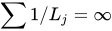
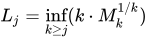
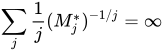
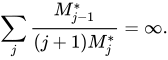
The proof that the last two conditions are equivalent to the second uses Carleman's inequality.
Example: Denjoy (1921) pointed out that if Mn is given by one of the sequences

then the corresponding class is quasi-analytic. The first sequence gives analytic functions.
Additional properties
editFor a logarithmically convex sequence the following properties of the corresponding class of functions hold:
- contains the analytic functions, and it is equal to it if and only if
- If is another logarithmically convex sequence, with for some constant , then .
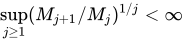
- is stable under differentiation if and only if .
- For any infinitely differentiable function there are quasi-analytic rings and and elements , and , such that .





Weierstrass division
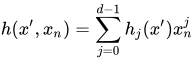
editA function is said to be regular of order with respect to if and . Given regular of order with respect to , a ring of real or complex functions of variables is said to satisfy the Weierstrass division with respect to if for every there is , and such that






- with .

While the ring of analytic functions and the ring of formal power series both satisfy the Weierstrass division property, the same is not true for other quasi-analytic classes.
If is logarithmically convex and is not equal to the class of analytic function, then does not satisfy the Weierstrass division property with respect to .

References
edit- Carleman, T. (1926), Les fonctions quasi-analytiques, Gauthier-Villars
- Cohen, Paul J. (1968), "A simple proof of the Denjoy–Carleman theorem", The American Mathematical Monthly, 75 (1), Mathematical Association of America: 26–31, doi:10.2307/2315100, ISSN 0002-9890, JSTOR 2315100, MR 0225957
- Denjoy, A. (1921), "Sur les fonctions quasi-analytiques de variable réelle", C. R. Acad. Sci. Paris, 173: 1329–1331
- Hörmander, Lars (1990), The Analysis of Linear Partial Differential Operators I, Springer-Verlag, ISBN 3-540-00662-1
- Leont'ev, A.F. (2001) [1994], "Quasi-analytic class", Encyclopedia of Mathematics, EMS Press
- Solomentsev, E.D. (2001) [1994], "Carleman theorem", Encyclopedia of Mathematics, EMS Press
