This article includes a list of references, related reading, or external links, but its sources remain unclear because it lacks inline citations. (May 2024) |
In mathematics, quantales are certain partially ordered algebraic structures that generalize locales (point free topologies) as well as various multiplicative lattices of ideals from ring theory and functional analysis (C*-algebras, von Neumann algebras).[1] Quantales are sometimes referred to as complete residuated semigroups.
Overview
editA quantale is a complete lattice with an associative binary operation , called its multiplication, satisfying a distributive property such that


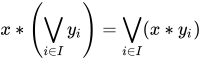
and
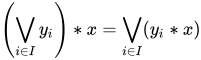
for all and (here is any index set). The quantale is unital if it has an identity element for its multiplication:



for all . In this case, the quantale is naturally a monoid with respect to its multiplication .


A unital quantale may be defined equivalently as a monoid in the category Sup of complete join-semilattices.
A unital quantale is an idempotent semiring under join and multiplication.
A unital quantale in which the identity is the top element of the underlying lattice is said to be strictly two-sided (or simply integral).
A commutative quantale is a quantale whose multiplication is commutative. A frame, with its multiplication given by the meet operation, is a typical example of a strictly two-sided commutative quantale. Another simple example is provided by the unit interval together with its usual multiplication.
An idempotent quantale is a quantale whose multiplication is idempotent. A frame is the same as an idempotent strictly two-sided quantale.
An involutive quantale is a quantale with an involution
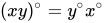
that preserves joins:
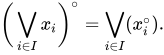
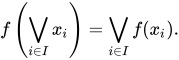
A quantale homomorphism is a map that preserves joins and multiplication for all and :



See also
editReferences
edit- ^ Paseka, Jan; Slesinger, Radek (2018). "A Representation Theorem for Quantale Valued sup-algebras". 2018 IEEE 48th International Symposium on Multiple-Valued Logic (ISMVL). pp. 91–96. arXiv:1810.09561. doi:10.1109/ISMVL.2018.00024. ISBN 978-1-5386-4464-5 – via IEEE Xplore.
- C.J. Mulvey (2001) [1994], "Quantale", Encyclopedia of Mathematics, EMS Press [1] Archived 2020-07-27 at the Wayback Machine
- J. Paseka, J. Rosicky, Quantales, in: B. Coecke, D. Moore, A. Wilce, (Eds.), Current Research in Operational Quantum Logic: Algebras, Categories and Languages, Fund. Theories Phys., vol. 111, Kluwer Academic Publishers, 2000, pp. 245–262.
- M. Piazza, M. Castellan, Quantales and structural rules. Journal of Logic and Computation, 6 (1996), 709–724.
- K. Rosenthal, Quantales and Their Applications, Pitman Research Notes in Mathematics Series 234, Longman Scientific & Technical, 1990.
 | This abstract algebra–related article is a stub. You can help Wikipedia by adding missing information. |
