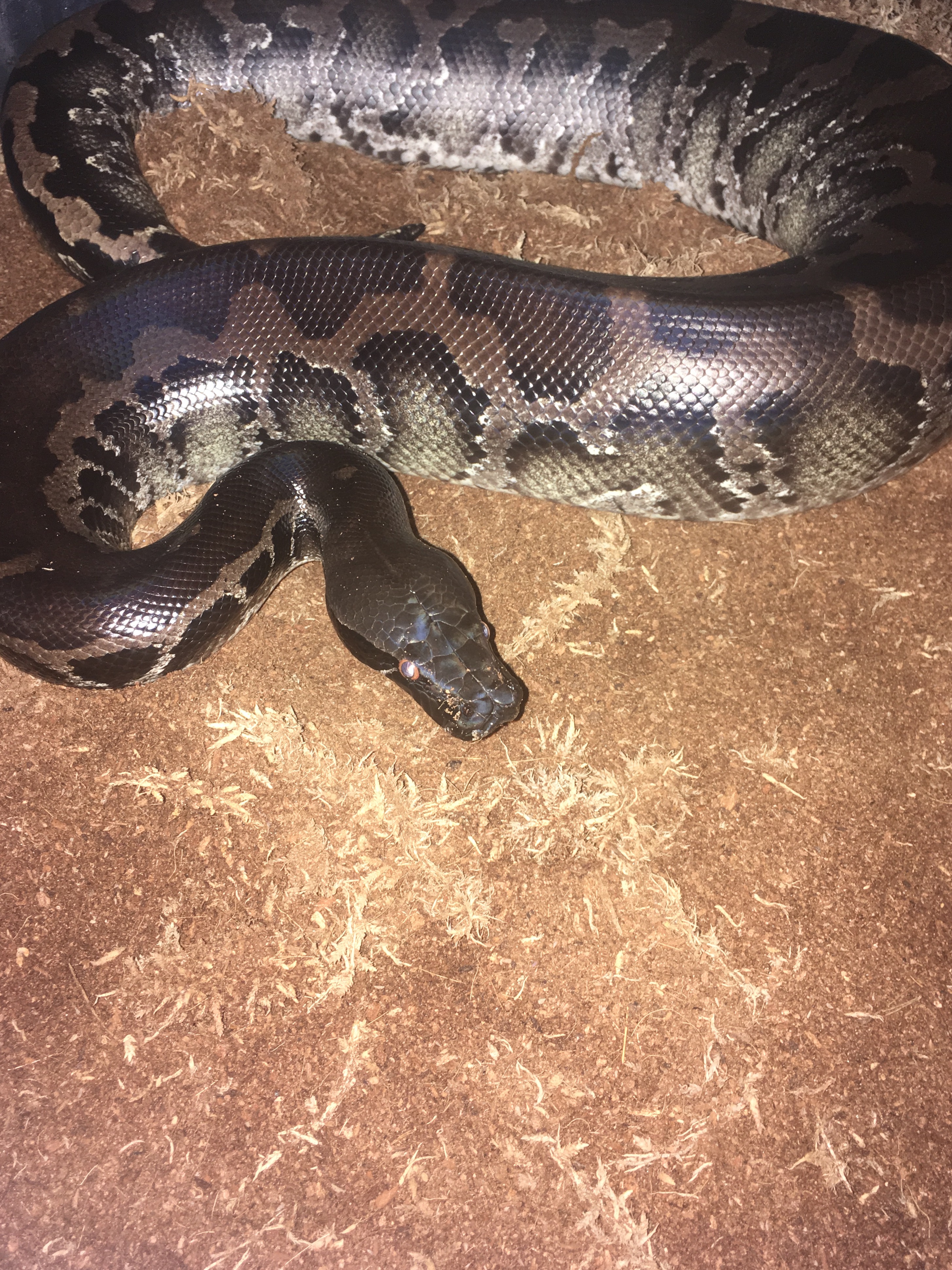
| Sumatran short-tailed python | |
|---|---|
| |
Scientific classification 
| |
| Kingdom: | Animalia |
| Phylum: | Chordata |
| Class: | Reptilia |
| Order: | Squamata |
| Suborder: | Serpentes |
| Family: | Pythonidae |
| Genus: | Python |
| Species: | P. curtus
|
| Binomial name | |
| Python curtus Schlegel, 1872
| |
| Synonyms | |
|
Aspidoboa curta Sauvage, 1884 | |

The Sumatran short-tailed python[1] (Python curtus), also called the Sumatra python,[2] is a species of the family Pythonidae, a nonvenomous snake native to Sumatra.[1]
Taxonomy
edit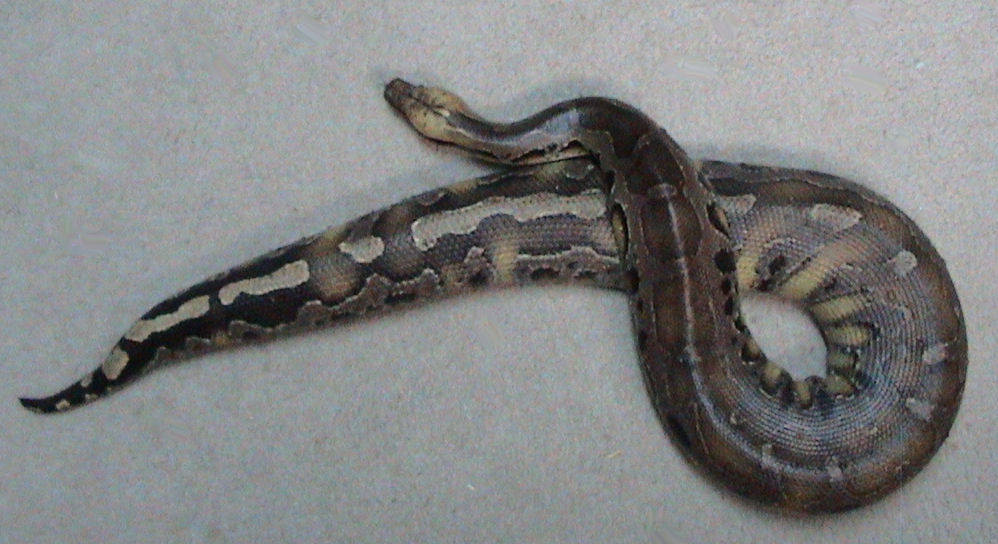
Python curtus was the scientific name proposed by Hermann Schlegel in 1872 for a python with a short tail from Sumatra.[3] The type locality is Sumatra.[4]
Python brongersmai and P. breitensteini were often considered the same species as P. curtus until confirmed distinct around 2000.
Description
edit
The Sumatran short-tailed python has narrow subocular scales between the bottom of the eye and the top of the labial scales. The parietal scales do not join each other. P. curtus and P. breitensteini can be distinguished by the frontal and parietal scales on the tops of their heads. In both P. brongersmai and P. breitensteini, the parietal scales join. Adults grow to 1.1–1.5 m (3.6–4.9 ft) in length and are heavily built. The tail is extremely short relative to the overall length. The color pattern consists of a beige, tan, or grayish-brown ground color overlaid with blotches that are reddish in color.[5][needs update]
Distribution and habitat
editThe Sumatran short-tailed python occurs in Sumatra, Riau Archipelago, Lingga Islands, Bangka Islands, Mentawai Islands and Kalimantan.[1] It inhabits rainforests, marshes, swamps, and the vicinity of river banks and streams.[5]
Behaviour and ecology
editThe Sumatran short-tailed python feeds on mammals and birds.[5]
Reproduction
editThe Sumatran short-tailed python is oviparous, and females seldom lay more than a dozen large eggs. The female remains coiled around the eggs during the incubation period, and may shiver to produce heat if surrounding temperatures drop below 90 °F (32 °C). The hatchlings emerge after 2.5 to 3.0 months and are about 30 cm (12 in) long.[5]
Uses
editThe species is kept as an exotic pet. They are often regarded as unpredictable and aggressive, but captive-bred individuals, with proper husbandry and handling are excellent intermediate level reptiles that tend to be more docile than wild-caught specimens. These animals should only be kept by experienced reptile keepers, they are not a beginner species due to size and handling requirements.
The Sumatran short-tailed python has been extensively harvested for leather; an estimated 100,000 individuals are taken for this purpose each year. The commercial trade regards the various populations of P. curtus and P. brongersmai as a single species. Authors who elevate particular island populations to species status note that the skins are readily distinguished.[6]
References
edit- ^ a b c d Inger, R.F.; Iskandar, D.; Lilley, R.; Jenkins, H.; Das, I. (2014). "Python curtus". IUCN Red List of Threatened Species. 2014 e.T192244A2060581. doi:10.2305/IUCN.UK.2014-1.RLTS.T192244A2060581.en. Retrieved 19 November 2021.
- ^ Python curtus at the Reptarium.cz Reptile Database. Accessed 11 September 2007.
- ^ Schlegel, H. (1872). "De Pythons". In Witkamp, P. H. (ed.). De Diergaarde van het Koninklijk Zoölogisch Genootschap Natura Artis Magistra te Amsterdam: De Kruipende Dieren. Amsterdam: Van Es. pp. 53–54.
- ^ McDiarmid, R. W., Campbell, J. A., Touré, T. 1999. Snake Species of the World: A Taxonomic and Geographic Reference, vol. 1. Herpetologists' League. 511 pp. ISBN 1-893777-00-6 (series). ISBN 1-893777-01-4 (volume).
- ^ a b c d Mehrtens, J. M. 1987. Living Snakes of the World in Color. New York: Sterling Publishers. 480 pp. ISBN 0-8069-6460-X.
- ^ Keogh, J. Scott; Barker, David; Shine, Richard (2001). "Heavily exploited but poorly known: systematics and biogeography of commercially harvested pythons (Python curtus group) in Southeast Asia (abstract)". Biological Journal of the Linnean Society. 73 (1): 113. doi:10.1111/j.1095-8312.2001.tb01350.x.
External links
edit
- Python curtus at the Reptarium.cz Reptile Database. Accessed 11 September 2007.
