This article includes a list of general references, but it lacks sufficient corresponding inline citations. (March 2015) |
In mathematics, the attractor of a random dynamical system may be loosely thought of as a set to which the system evolves after a long enough time. The basic idea is the same as for a deterministic dynamical system, but requires careful treatment because random dynamical systems are necessarily non-autonomous. This requires one to consider the notion of a pullback attractor or attractor in the pullback sense.
Set-up and motivation
editConsider a random dynamical system on a complete separable metric space , where the noise is chosen from a probability space with base flow .



A naïve definition of an attractor for this random dynamical system would be to require that for any initial condition , as . This definition is far too limited, especially in dimensions higher than one. A more plausible definition, modelled on the idea of an omega-limit set, would be to say that a point lies in the attractor if and only if there exists an initial condition, , and there is a sequence of times such that





- as .


This is not too far from a working definition. However, we have not yet considered the effect of the noise , which makes the system non-autonomous (i.e. it depends explicitly on time). For technical reasons, it becomes necessary to do the following: instead of looking seconds into the "future", and considering the limit as , one "rewinds" the noise seconds into the "past", and evolves the system through seconds using the same initial condition. That is, one is interested in the pullback limit


- .
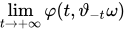
So, for example, in the pullback sense, the omega-limit set for a (possibly random) set is the random set


Equivalently, this may be written as

Importantly, in the case of a deterministic dynamical system (one without noise), the pullback limit coincides with the deterministic forward limit, so it is meaningful to compare deterministic and random omega-limit sets, attractors, and so forth.
Several examples of pullback attractors of non-autonomous dynamical systems are presented analytically and numerically.[1]
Definition
editThe pullback attractor (or random global attractor) for a random dynamical system is a -almost surely unique random set such that


- is a random compact set: is almost surely compact and is a -measurable function for every ;
- is invariant: for all almost surely;
- is attractive: for any deterministic bounded set ,






- almost surely.

There is a slight abuse of notation in the above: the first use of "dist" refers to the Hausdorff semi-distance from a point to a set,

whereas the second use of "dist" refers to the Hausdorff semi-distance between two sets,

As noted in the previous section, in the absence of noise, this definition of attractor coincides with the deterministic definition of the attractor as the minimal compact invariant set that attracts all bounded deterministic sets.
Theorems relating omega-limit sets to attractors
editThe attractor as a union of omega-limit sets
editIf a random dynamical system has a compact random absorbing set , then the random global attractor is given by

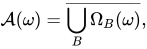
where the union is taken over all bounded sets .
Bounding the attractor within a deterministic set
editCrauel (1999) proved that if the base flow is ergodic and is a deterministic compact set with



then -almost surely.

References
edit- ^ Li, Jeremiah H.; Ye, Felix X. -F.; Qian, Hong; Huang, Sui (2019-08-01). "Time-dependent saddle–node bifurcation: Breaking time and the point of no return in a non-autonomous model of critical transitions". Physica D: Nonlinear Phenomena. 395: 7–14. arXiv:1611.09542. doi:10.1016/j.physd.2019.02.005. ISSN 0167-2789. PMC 6836434. PMID 31700198.
Further reading
edit- Crauel, Hans; Debussche, Arnaud; Flandoli, Franco (1 April 1997). "Random attractors". Journal of Dynamics and Differential Equations. 9 (2): 307–341. Bibcode:1997JDDE....9..307C. doi:10.1007/BF02219225. hdl:11568/53248. ISSN 1040-7294. S2CID 192603977. Retrieved 13 July 2023.
- Crauel, Hans (1 December 1999). "Global random attractors are uniquely determined by attracting deterministic compact sets". Annali di Matematica Pura ed Applicata. 176 (1): 57–72. doi:10.1007/BF02505989. ISSN 1618-1891. S2CID 119417673. Retrieved 13 July 2023.
- Chekroun, Mickaël D.; Simonnet, Eric; Ghil, Michael (1 October 2011). "Stochastic climate dynamics: Random attractors and time-dependent invariant measures" (PDF). Physica D: Nonlinear Phenomena. 240 (21): 1685–1700. Bibcode:2011PhyD..240.1685C. doi:10.1016/j.physd.2011.06.005. ISSN 0167-2789. HAL hal-01120519. Retrieved 13 July 2023.
