Pocklington's algorithm is a technique for solving a congruence of the form

where x and a are integers and a is a quadratic residue.
The algorithm is one of the first efficient methods to solve such a congruence. It was described by H.C. Pocklington in 1917.[1]
The algorithm
edit
(Note: all  are taken to mean
  , unless indicated otherwise.)
Inputs:
- p, an odd prime
- a, an integer which is a quadratic residue .
Outputs:
- x, an integer satisfying
 . Note that if x is a solution, −x is a solution as well and since p is odd,
  . So there is always a second solution when one is found.
Solution method
edit
Pocklington separates 3 different cases for p:
The first case, if  , with
  , the solution is
  .
.
The second case, if  , with and
 , the solution is .
 , 2 is a (quadratic) non-residue so
  . This means that
 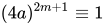 so
so 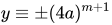 is a solution of
  . Hence
  or, if y is odd,
  .
.
The third case, if  , put
, put  , so the equation to solve becomes
  . Now find by trial and error
  and
and  so that
 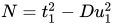 is a quadratic non-residue. Furthermore, let
 .
.
The following equalities now hold:
 .
.
Supposing that p is of the form  (which is true if p is of the form
  ), D is a quadratic residue and
  . Now the equations

give a solution  .
.
Let  . Then
  . This means that either
  or
or  is divisible by p. If it is , put
  and proceed similarly with
  . Not every
  is divisible by p, for is not. The case
  with m odd is impossible, because
  holds and this would mean that
  is congruent to a quadratic non-residue, which is a contradiction. So this loop stops when
  for a particular l. This gives
  , and because
  is a quadratic residue, l must be even. Put
  . Then
  . So the solution of is got by solving the linear congruence
  .
.
Examples
edit
The following are 4 examples, corresponding to the 3 different cases in which Pocklington divided forms of p. All are taken with the modulus in the example.
Example 0
edit

This is the first case, according to the algorithm,
 , but then
  not 43, so we should not apply the algorithm at all. The reason why the algorithm is not applicable is that a=43 is a quadratic non residue for p=47.
Example 1
edit
Solve the congruence

The modulus is 23. This is  , so
, so  . The solution should be
  , which is indeed true:
  .
.
Example 2
edit
Solve the congruence

The modulus is 13. This is  , so
, so  . Now verifying
  . So the solution is
  . This is indeed true:
  .
.
Example 3
edit
Solve the congruence  . For this, write
  . First find a and such that
  is a quadratic nonresidue. Take for example
  . Now find
  ,
,  by computing


And similarly  such that
Since  , the equation
  which leads to solving the equation
  . This has solution
  . Indeed,
  .
.
References
edit
- Leonard Eugene Dickson, "History Of The Theory Of Numbers" vol 1 p 222, Chelsea Publishing 1952
- ^ H.C. Pocklington, Proceedings of the Cambridge Philosophical Society, Volume 19, pages 57–58
