In mathematics, plurisubharmonic functions (sometimes abbreviated as psh, plsh, or plush functions) form an important class of functions used in complex analysis. On a Kähler manifold, plurisubharmonic functions form a subset of the subharmonic functions. However, unlike subharmonic functions (which are defined on a Riemannian manifold) plurisubharmonic functions can be defined in full generality on complex analytic spaces.
Formal definition
editA function with domain is called plurisubharmonic if it is upper semi-continuous, and for every complex line


- with


the function is a subharmonic function on the set
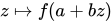

In full generality, the notion can be defined on an arbitrary complex manifold or even a complex analytic space as follows. An upper semi-continuous function is said to be plurisubharmonic if for any holomorphic map the function is subharmonic, where denotes the unit disk.





Differentiable plurisubharmonic functions
editIf is of (differentiability) class , then is plurisubharmonic if and only if the hermitian matrix , called Levi matrix, with entries


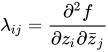
Equivalently, a -function f is plurisubharmonic if and only if is a positive (1,1)-form.

Examples
editRelation to Kähler manifold: On n-dimensional complex Euclidean space , is plurisubharmonic. In fact, is equal to the standard Kähler form on up to constant multiples. More generally, if satisfies


for some Kähler form , then is plurisubharmonic, which is called Kähler potential. These can be readily generated by applying the ddbar lemma to Kähler forms on a Kähler manifold.

Relation to Dirac Delta: On 1-dimensional complex Euclidean space , is plurisubharmonic. If is a C∞-class function with compact support, then Cauchy integral formula says


which can be modified to
- .

It is nothing but Dirac measure at the origin 0 .
More Examples
- If is an analytic function on an open set, then is plurisubharmonic on that open set.
- Convex functions are plurisubharmonic.
- If is a domain of holomorphy then is plurisubharmonic.



History
editPlurisubharmonic functions were defined in 1942 by Kiyoshi Oka[1] and Pierre Lelong.[2]
Properties
edit- The set of plurisubharmonic functions has the following properties like a convex cone:
- if is a plurisubharmonic function and a positive real number, then the function is plurisubharmonic,
- if and are plurisubharmonic functions, then the sum is a plurisubharmonic function.


- Plurisubharmonicity is a local property, i.e. a function is plurisubharmonic if and only if it is plurisubharmonic in a neighborhood of each point.
- If is plurisubharmonic and an increasing convex function then is plurisubharmonic. ( is interpreted as .)
- If and are plurisubharmonic functions, then the function is plurisubharmonic.
- The pointwise limit of a decreasing sequence of plurisubharmonic functions is plurisubharmonic.
- Every continuous plurisubharmonic function can be obtained as the limit of a decreasing sequence of smooth plurisubharmonic functions. Moreover, this sequence can be chosen uniformly convergent.[3]
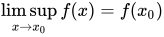
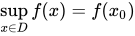
- The inequality in the usual semi-continuity condition holds as equality, i.e. if is plurisubharmonic then .
- Plurisubharmonic functions are subharmonic, for any Kähler metric.
- Therefore, plurisubharmonic functions satisfy the maximum principle, i.e. if is plurisubharmonic on the domain and for some point then is constant.




Applications
editIn several complex variables, plurisubharmonic functions are used to describe pseudoconvex domains, domains of holomorphy and Stein manifolds.
Oka theorem
editThe main geometric application of the theory of plurisubharmonic functions is the famous theorem proven by Kiyoshi Oka in 1942.[1]
A continuous function is called exhaustive if the preimage is compact for all . A plurisubharmonic function f is called strongly plurisubharmonic if the form is positive, for some Kähler form on M.

![{\displaystyle f^{-1}((-\infty ,c])}](https://wikimedia.org/api/rest_v1/media/math/render/svg/92c8aebf8bf641686544c3cbc9ffa7d51749f3f8)


Theorem of Oka: Let M be a complex manifold, admitting a smooth, exhaustive, strongly plurisubharmonic function. Then M is a Stein manifold. Conversely, any Stein manifold admits such a function.
References
edit- Bremermann, H. J. (1956). "Complex Convexity". Transactions of the American Mathematical Society. 82 (1): 17–51. doi:10.1090/S0002-9947-1956-0079100-2. JSTOR 1992976.
- Steven G. Krantz. Function Theory of Several Complex Variables, AMS Chelsea Publishing, Providence, Rhode Island, 1992.
- Robert C. Gunning. Introduction to Holomorphic Functions in Several Variables, Wadsworth & Brooks/Cole.
- Klimek, Pluripotential Theory, Clarendon Press 1992.
External links
edit- "Plurisubharmonic function", Encyclopedia of Mathematics, EMS Press, 2001 [1994]
Notes
edit- ^ a b Oka, Kiyoshi (1942), "Sur les fonctions analytiques de plusieurs variables. VI. Domaines pseudoconvexes", Tohoku Mathematical Journal, First Series, 49: 15–52, ISSN 0040-8735, Zbl 0060.24006 note:In the treatise, it is referred to as the pseudoconvex function, but this means the plurisubharmonic function, which is the subject of this page, not the pseudoconvex function of convex analysis.Bremermann (1956)
- ^ Lelong, P. (1942). "Definition des fonctions plurisousharmoniques". C. R. Acad. Sci. Paris. 215: 398–400.
- ^ R. E. Greene and H. Wu, -approximations of convex, subharmonic, and plurisubharmonic functions, Ann. Scient. Ec. Norm. Sup. 12 (1979), 47–84.

