In the mathematical study of harmonic functions, the Perron method, also known as the method of subharmonic functions, is a technique introduced by Oskar Perron for the solution of the Dirichlet problem for Laplace's equation. The Perron method works by finding the largest subharmonic function with boundary values below the desired values; the "Perron solution" coincides with the actual solution of the Dirichlet problem if the problem is soluble.
The Dirichlet problem is to find a harmonic function in a domain, with boundary conditions given by a continuous function . The Perron solution is defined by taking the pointwise supremum over a family of functions ,


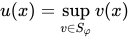
where is the set of all subharmonic functions such that on the boundary of the domain.

The Perron solution u(x) is always harmonic; however, the values it takes on the boundary may not be the same as the desired boundary values . A point y of the boundary satisfies a barrier condition if there exists a superharmonic function , defined on the entire domain, such that and for all . Points satisfying the barrier condition are called regular points of the boundary for the Laplacian. These are precisely the points at which one is guaranteed to obtain the desired boundary values: as .



The characterization of regular points on surfaces is part of potential theory. Regular points on the boundary of a domain are those points that satisfy the Wiener criterion: for any , let be the capacity of the set ; then is a regular point if and only if


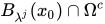

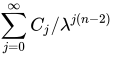
diverges.
The Wiener criterion was first devised by Norbert Wiener; it was extended by Werner Püschel to uniformly elliptic divergence-form equations with smooth coefficients, and thence to uniformly elliptic divergence form equations with bounded measureable coefficients by Walter Littman, Guido Stampacchia, and Hans Weinberger.
References
edit- Gilbarg, David; Trudinger, Neil S. (2001), Elliptic partial differential equations of second order (2nd ed.), Berlin, New York: Springer-Verlag, ISBN 978-3-540-41160-4
- Littman, W.; Stampacchia, G.; Weinberger, H. (1963), "Regular points for elliptic equations with discontinuous coefficients", Annali della Scuola Normale Superiore di Pisa, Classe di Scienze, 3, vol. 17, no. 1–2, Pisa, Italy: Scuola Normale Superiore di Pisa, pp. 43–77 MR 0161019
Further reading
edit- Conway, John B. (1996-06-13), Functions of One Complex Variable II, Graduate Texts in Mathematics, vol. 159, Springer-Verlag, pp. 376–383, ISBN 978-0-387-94460-9
- Kellogg, O. D. (1953), Foundations of potential theory, New York: Dover Publications, ISBN 978-0-486-60144-1
{{citation}}: ISBN / Date incompatibility (help) - Landkof, N. S. (1972), Foundations of modern potential theory, Berlin, New York: Springer-Verlag, MR 0350027
- Perron, O. (December 1923), "Eine neue Behandlung der ersten Randwertaufgabe für Δu=0", Mathematische Zeitschrift, 18 (1): 42–54, doi:10.1007/BF01192395, ISSN 0025-5874, S2CID 122843531
- Püschel, Werner (1932), "Die erste Randwertaufgabe der allgemeinen selbstadjungierten elliptischen Differentialgleichung zweiter Ordnung im Raum für beliebige Gebiete", Mathematische Zeitschrift, 34 (1): 535–553, doi:10.1007/BF01180608, ISSN 0025-5874, MR 1545272, S2CID 121882212
- Solomentsev, E.D. (2001) [1994], "Perron method", Encyclopedia of Mathematics, EMS Press
 | This mathematical analysis–related article is a stub. You can help Wikipedia by adding missing information. |
