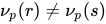
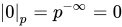
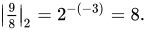
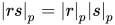
In number theory, the p-adic valuation or p-adic order of an integern is the exponent of the highest power of the prime numberp that dividesn.
It is denoted or .
Equivalently, is the exponent to which appears in the prime factorization of .
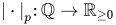
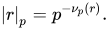
The p-adic valuation is a valuation and gives rise to an analogue of the usual absolute value, though unlike the latter, the p-adic absolute value is not Archimedean.
Whereas the completion of the rational numbers with respect to the usual absolute value results in the real numbers, the completion of the rational numbers with respect to the p-adic absolute value results in the p-adic numbers.[1]
Distribution of natural numbers by their 2-adic valuation, labeled with corresponding powers of two in decimal. Zero has an infinite valuation.
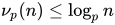
The choice of base p in the exponentiation makes no difference for most of the properties, but supports the product formula:
where the product is taken over all primes p and the usual absolute value, denoted . This follows from simply taking the prime factorization: each prime power factor contributes its reciprocal to its p-adic absolute value, and then the usual Archimedean absolute value cancels all of them.
By Ostrowski's theorem, the usual and p-adic absolute values occurring in the formula are all the absolute values on the rational numbers up to equivalence. An analogous product formula can be used to axiomatically define global fields, of which the rational numbers are the simplest example.
The completion of with respect to this metric leads to the set of p-adic numbers. Like the rationals, they form a field, and the p-adic valuation and absolute value can be extended to , making it a complete valued field.
respect to the p-adic absolute value. This allows considering rational numbers as special p-adic numbers, and alternatively defining the p-adic numbers as
with p. The p-adic absolute value on the p-adic numbers, arising from the completion (see § Completions below) of the rationals with the absolute value defined
every non-trivial absolute value on the rational numbers Q is equivalent to either the usual real absolute value or a p-adic absolute value. Mahler's theorem
p-adic absolute value, which conventionally has as base 1 / p = p − 1 {\displaystyle 1/p=p^{-1}} , so | a | p := p − ν p ( a ) {\displaystyle |a|_{p}:=p^{-\nu
non-trivial absolute value on the rational numbers Q {\displaystyle \mathbb {Q} } is equivalent to either the usual real absolute value or a p-adic absolute value
usual absolute value or some p {\displaystyle p} -adic absolute value. The rational field is not complete with respect to non-trivial absolute values; with