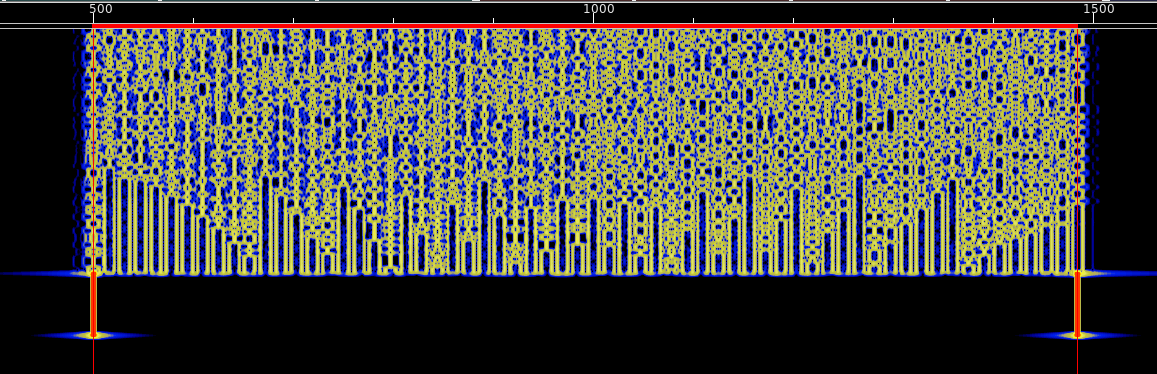
MT63 is a digital radio modulation mode for transmission in high-noise situations. It was developed by Pawel Jalocha, call sign SP9VRC, primarily for keyboard-to-keyboard conversations on HF amateur radio bands.
Description
editMT63 distributes the encoding of each character over a long time period, and over several tones. This code and symbol spreading implementation is key to its robustness under less than ideal conditions. The MT63 mode is very tolerant of mistuning; most software will handle 120 Hz tuning offsets under normal conditions.
| Mode | Symbol rate | Typing speed | Duty cycle | Modulation | Bandwidth | ITU designation |
|---|---|---|---|---|---|---|
| MT63-500 | 5 baud | 5.0 cps (50 wpm) | 80% | 64 × 2-PSK | 500 Hz | 500HJ2DEN |
| MT63-1000 | 10 baud | 10.0 cps (100 wpm) | 80% | 64 × 2-PSK | 1000 Hz | 1K00J2DEN |
| MT63-2000 | 20 baud | 20.0 cps (200 wpm) | 80% | 64 × 2-PSK | 2000 Hz | 2K00J2DEN |
Latency
editMT63 can use either a short or long interleaver. The long interleaver makes the mode more robust against interference, at the cost of increasing latency.
| Mode | ECC mode | Latency (sec) |
|---|---|---|
| MT63 500 Hz | short | 12.8 |
| MT63 1K | short | 6.4 |
| MT63 1K | long | 12.8 |
| MT63 2K | short | 3.2 |
| MT63 2K | long | 6.4 |
| PSK31 | - | <1 |
Media
edit
MT63 was used on shortwave by the VOA Radiogram until 2017,[1] but the software used to encode the text was not using the Varicode that MT63 used in its original design.
Modern software that supports MT63, such as Fldigi, uses base128,[2] essentially the same as ASCII.
MT63 has been promoted as a modulation format for time signal stations, but this system does not use Varicode.[3]
See also
editReferences
edit- ^ "VOA Radiogram".
- ^ "MT63 Modes".
- ^ "Wide Area Time Service with Extended Features". Archived from the original on 2007-09-27. Retrieved 2013-05-21.
Related links
edit- "MT63 Technical Information", ZL1BPU website (archived 2008)
- "MT63", ZL1BPU website (archived 2008)
- BARTG site - British Amateur Radio Teledata Group
- Fldigi MT63
- MT63 mooted as a time transfer technology Archived 2007-09-27 at the Wayback Machine
