This article is about a specific ordering on real vectors. For ordering in general, see Partially ordered set.
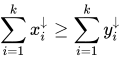
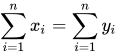
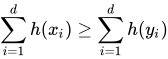
In mathematics, majorization is a preorder on vectors of real numbers. For two such vectors, , we say that weakly majorizes (or dominates) from below, commonly denoted when
for all ,
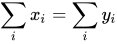
where denotes the th largest entry of . If further satisfy , we say that majorizes (or dominates) , commonly denoted .
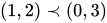
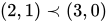
Both weak majorization and majorization are partial orders for vectors whose entries are non-decreasing, but only a preorder for general vectors, since majorization is agnostic to the ordering of the entries in vectors, e.g., the statement is simply equivalent to .
Specifically, if and only if are permutations of each other. Similarly for .
Majorizing also sometimes refers to entrywise ordering, e.g. the real-valued function f majorizes the real-valued function g when for all in the domain, or other technical definitions, such as majorizing measures in probability theory.[1]
For we have if and only if is in the convex hull of all vectors obtained by permuting the coordinates of . This is equivalent to saying that for some doubly stochastic matrix.[2]: Thm. 2.1 In particular, can be written as a convex combination of permutations of .[3] In other words, is in the permutahedron of .
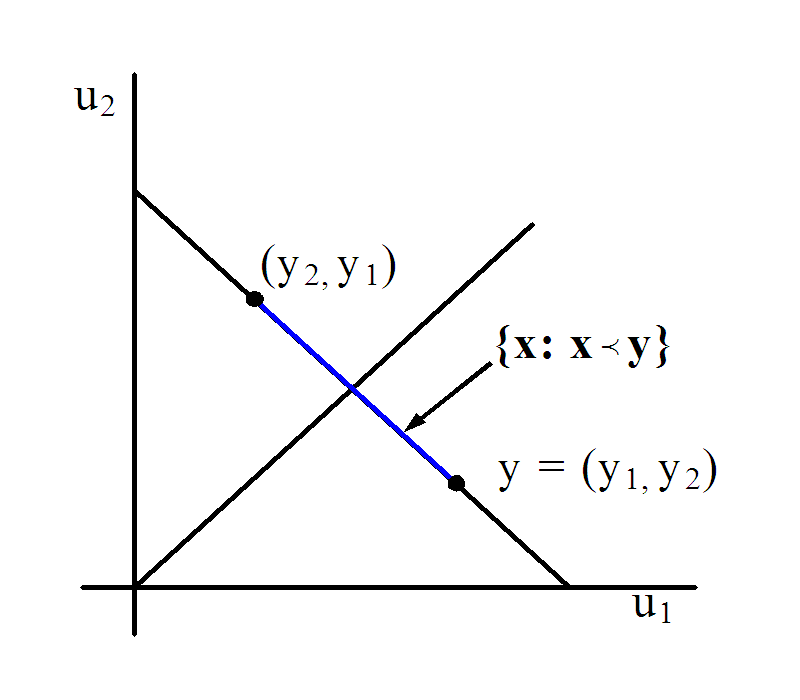
Figure 1 displays the convex hull in 2D for the vector . Notice that the center of the convex hull, which is an interval in this case, is the vector . This is the "smallest" vector satisfying for this given vector .
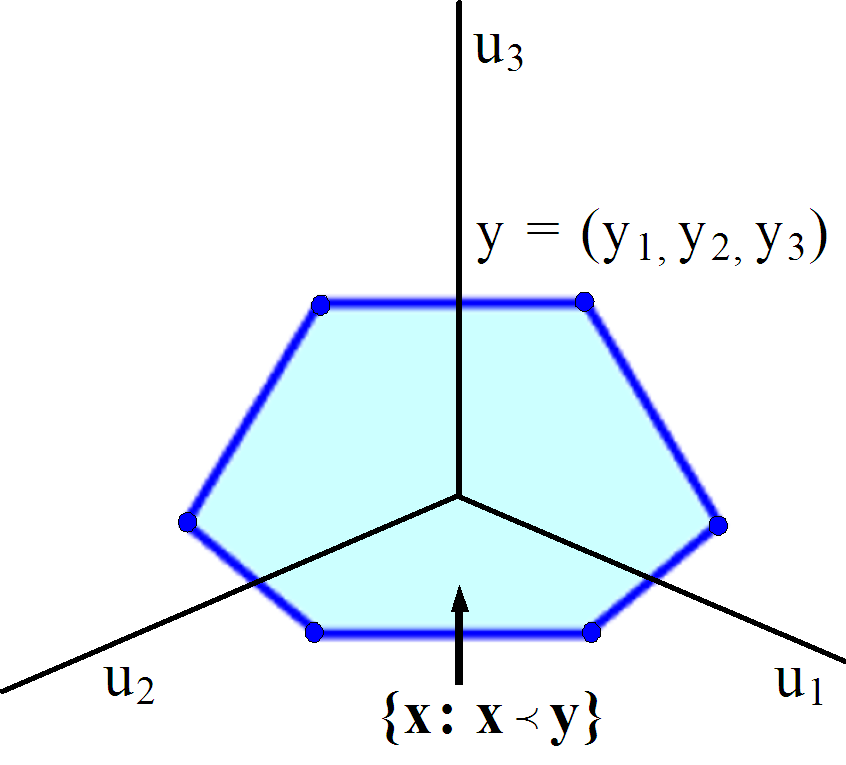
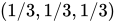
Figure 2 shows the convex hull in 3D. The center of the convex hull, which is a 2D polygon in this case, is the "smallest" vector satisfying for this given vector .
Figure 2. 3D Majorization Example
Other definitions
edit
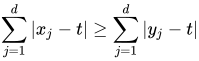
Each of the following statements is true if and only if .
From we can produce by a finite sequence of "Robin Hood operations" where we replace two elements and with and , respectively, for some .[2]: 11
Three vectors and their concave curves, illustrating .Each vector can be plotted as a concave curve by connecting . Then is equivalent to the curve of being higher than that of .
Examples
edit
Among non-negative vectors with three components, and permutations of it majorize all other vectors such that . For example, . Similarly, is majorized by all other such vectors, so .
This behavior extends to general-length probability vectors: the singleton vector majorizes all other probability vectors, and the uniform distribution is majorized by all probability vectors.
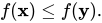
A function is said to be Schur convex when implies . Hence, Schur-convex functions translate the ordering of vectors to a standard ordering in . Similarly, is Schur concave when implies
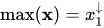
An example of a Schur-convex function is the max function, . Schur convex functions are necessarily symmetric that the entries of it argument can be switched without modifying the value of the function. Therefore, linear functions, which are convex, are not Schur-convex unless they are symmetric. If a function is symmetric and convex, then it is Schur-convex.
^ abcBarry C. Arnold. "Majorization and the Lorenz Order: A Brief Introduction". Springer-Verlag Lecture Notes in Statistics, vol. 43, 1987.
^Xingzhi, Zhan (2003). "The sharp Rado theorem for majorizations". The American Mathematical Monthly. 110 (2): 152–153. doi:10.2307/3647776. JSTOR3647776.
^Marshall, Albert W. (2011). "14, 15". Inequalities : theory of majorization and its applications. Ingram Olkin, Barry C. Arnold (2nd ed.). New York: Springer Science+Business Media, LLC. ISBN978-0-387-68276-1. OCLC694574026.
Inequalities: Theory of Majorization and Its Applications Albert W. Marshall, Ingram Olkin, Barry Arnold, Second edition. Springer Series in Statistics. Springer, New York, 2011. ISBN978-0-387-40087-7
Karamata's inequality, named after Jovan Karamata, also known as the majorization inequality, is a theorem in elementary algebra for convex and concave
Stress majorization is an optimization strategy used in multidimensional scaling (MDS) where, for a set of n {\displaystyle n} m {\displaystyle m} -dimensional
Major Major Major Major is a fictional character in Joseph Heller's 1961 novel Catch-22. He was named "Major Major Major" by his father, as a joke – passing
Cauchy–Schwarz inequality Inequality of arithmetic and geometric means Quadratic majorization/mininorization via second order Taylor expansion of twice-differentiable
Look up Major or major in Wiktionary, the free dictionary. Major(s) or The Major may refer to: Major (rank), a military rank Academic major, an academic
contributions to meta-analysis, statistics education, multivariate analysis, and majorization theory. Olkin was born in 1924 in Waterbury, Connecticut. He received
A major is a major scale based on A, with the pitches A, B, C♯, D, E, F♯, and G♯. Its key signature has three sharps. Its relative minor is F-sharp minor
Named after Issai Schur, Schur-convex functions are used in the study of majorization. A function f is 'Schur-concave' if its negative, −f, is Schur-convex
























![{\displaystyle \mathrm {spec} [\rho ]\succ \mathrm {spec} [\rho ']}](https://wikimedia.org/api/rest_v1/media/math/render/svg/8ce600088bdf87c9d9eafe87cf150436ca811a92)


