In complex analysis and numerical analysis, Kőnig's theorem,[1] named after the Hungarian mathematician Gyula Kőnig, gives a way to estimate simple poles or simple roots of a function. In particular, it has numerous applications in root finding algorithms like Newton's method and its generalization Householder's method.
Statement
edit
Given a meromorphic function defined on  :
:
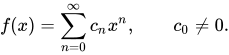
which only has one simple pole  in this disk. Then
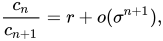
where  such that
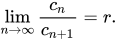
  . In particular, we have
Intuition
edit
Recall that
![{\displaystyle {\frac {C}{x-r}}=-{\frac {C}{r}}\,{\frac {1}{1-x/r}}=-{\frac {C}{r}}\sum _{n=0}^{\infty }\left[{\frac {x}{r}}\right]^{n},}](https://wikimedia.org/api/rest_v1/media/math/render/svg/085d5431b33eaa878e5a3dcf5dda8dccd71d4671)
which has coefficient ratio equal to 
Around its simple pole, a function 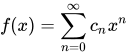 will vary akin to the geometric series and this will also be manifest in the coefficients of
  .
.
In other words, near x=r we expect the function to be dominated by the pole, i.e.
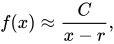
so that  .
.
References
edit
- ^ Householder, Alston Scott (1970). The Numerical Treatment of a Single Nonlinear Equation. McGraw-Hill. p. 115. LCCN 79-103908.
