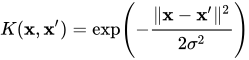
Since the value of the RBF kernel decreases with distance and ranges between zero (in the infinite-distance limit) and one (when x = x'), it has a ready interpretation as a similarity measure.[2]
The feature space of the kernel has an infinite number of dimensions; for , its expansion using the multinomial theorem is:[3]
Because support vector machines and other models employing the kernel trick do not scale well to large numbers of training samples or large numbers of features in the input space, several approximations to the RBF kernel (and similar kernels) have been introduced.[4]
Typically, these take the form of a function z that maps a single vector to a vector of higher dimensionality, approximating the kernel:
where is the implicit mapping embedded in the RBF kernel.
One way to construct such a z is to randomly sample from the Fourier transformation of the kernel[5]where are independent samples from the normal distribution .
Theorem:
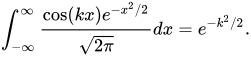
Proof: It suffices to prove the case of . Use the trigonometric identity , the spherical symmetry of Gaussian distribution, then evaluate the integral
In functional analysis, a reproducing kernel Hilbert space (RKHS) is a Hilbert space of functions in which point evaluation is a continuous linear functional
user-specified feature map: in contrast, kernel methods require only a user-specified kernel, i.e., a similarity function over all pairs of data points computed
The term kernel is used in statistical analysis to refer to a window function. The term "kernel" has several distinct meanings in different branches of
non-parametric method to estimate the probability density function of a random variable based on kernels as weights. KDE answers a fundamental data smoothing
a branch of mathematics, a positive-definite kernel is a generalization of a positive-definite function or a positive-definite matrix. It was first introduced
kernel is a computer program at the core of a computer's operating system that always has complete control over everything in the system. The kernel is
theory, the kernel of a function f {\displaystyle f} (or equivalence kernel) may be taken to be either the equivalence relation on the function's domain that





![{\displaystyle {\begin{alignedat}{2}\exp \left(-{\frac {1}{2}}\|\mathbf {x} -\mathbf {x'} \|^{2}\right)&=\exp \left({\frac {2}{2}}\mathbf {x} ^{\top }\mathbf {x'} -{\frac {1}{2}}\|\mathbf {x} \|^{2}-{\frac {1}{2}}\|\mathbf {x'} \|^{2}\right)\\[5pt]&=\exp \left(\mathbf {x} ^{\top }\mathbf {x'} \right)\exp \left(-{\frac {1}{2}}\|\mathbf {x} \|^{2}\right)\exp \left(-{\frac {1}{2}}\|\mathbf {x'} \|^{2}\right)\\[5pt]&=\sum _{j=0}^{\infty }{\frac {(\mathbf {x} ^{\top }\mathbf {x'} )^{j}}{j!}}\exp \left(-{\frac {1}{2}}\|\mathbf {x} \|^{2}\right)\exp \left(-{\frac {1}{2}}\|\mathbf {x'} \|^{2}\right)\\[5pt]&=\sum _{j=0}^{\infty }\quad \sum _{n_{1}+n_{2}+\dots +n_{k}=j}\exp \left(-{\frac {1}{2}}\|\mathbf {x} \|^{2}\right){\frac {x_{1}^{n_{1}}\cdots x_{k}^{n_{k}}}{\sqrt {n_{1}!\cdots n_{k}!}}}\exp \left(-{\frac {1}{2}}\|\mathbf {x'} \|^{2}\right){\frac {{x'}_{1}^{n_{1}}\cdots {x'}_{k}^{n_{k}}}{\sqrt {n_{1}!\cdots n_{k}!}}}\\[5pt]&=\langle \varphi (\mathbf {x} ),\varphi (\mathbf {x'} )\rangle \end{alignedat}}}](https://wikimedia.org/api/rest_v1/media/math/render/svg/c42c51e11b675698e01290de18306bcb7acc613f)





![{\displaystyle \varphi (x)={\frac {1}{\sqrt {D}}}[\cos \langle w_{1},x\rangle ,\sin \langle w_{1},x\rangle ,\ldots ,\cos \langle w_{D},x\rangle ,\sin \langle w_{D},x\rangle ]^{T}}](https://wikimedia.org/api/rest_v1/media/math/render/svg/1ebebe5193c52efc25a749492cf0269cd44e7f0d)


![{\displaystyle \operatorname {E} [\langle \varphi (x),\varphi (y)\rangle ]=e^{\|x-y\|^{2}/(2\sigma ^{2})}.}](https://wikimedia.org/api/rest_v1/media/math/render/svg/e2cc6c1d5eada384ef6b1f2a462dfa2089921bfb)


![{\displaystyle \operatorname {Var} [\langle \varphi (x),\varphi (y)\rangle ]=O(D^{-1})}](https://wikimedia.org/api/rest_v1/media/math/render/svg/e8ab3082dbba4fa920eee2c462249655c7908dc0)
