
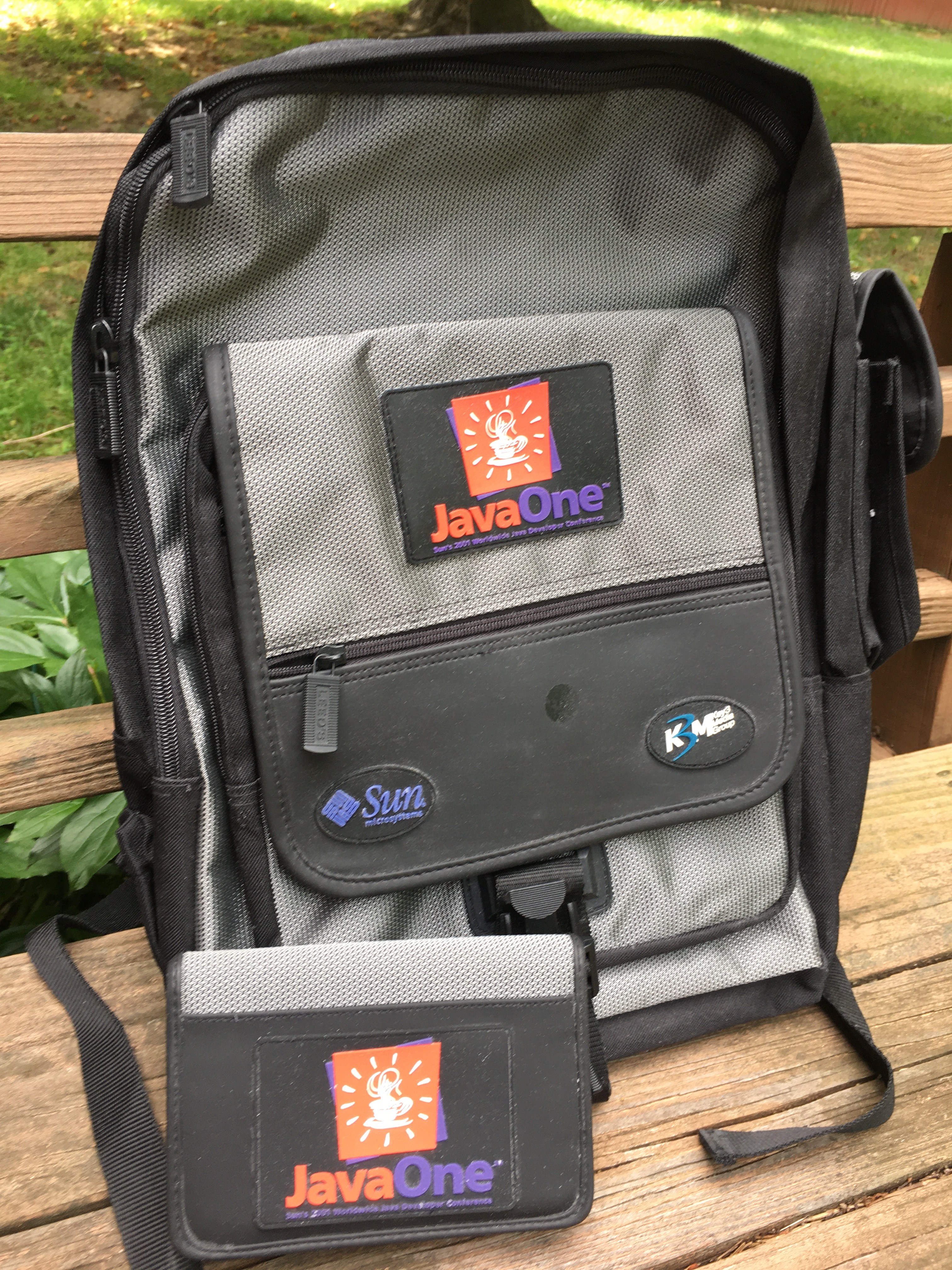
JavaOne is an annual conference first organized in 1996 by Sun Microsystems to discuss Java technologies, primarily among Java developers. It was held in San Francisco, California, typically running from a Monday to Thursday in summer months (early on) or in early fall months (later). Technical sessions and Birds of a Feather (BOF) sessions on a variety of Java-related topics were held throughout the week.
The show was very popular; for the 1999 edition, there were 20,000 attendees at the Moscone Center.[1]
For many years, the conference was hosted by Sun executive and Java evangelist John Gage.[1]
In 1999, the conference played host to an event called the Hackathon, a challenge set by Gage. Attendees were to write a program in Java for the new Palm V using the infrared port to communicate with other Palm users and register the device on the Internet.
During the 2008 conference, seventy Moscone Center staff members and three attendees were sickened by an outbreak of norovirus.[2]
After the acquisition of Sun by Oracle Corporation in 2010, the conference was held concurrently with Oracle OpenWorld. The conference was moved from Moscone Center to hotels on nearby Mason Street. In some years, one block of Mason was closed and covered with a tent, which formed part of the conference venue.
In April 2018, Oracle announced that the JavaOne conference would be discontinued, in favor of a more general programming conference called Oracle Code One.[3] The CodeOne conference ran for two years.
In March 2022, Oracle announced that JavaOne would return in October 2022,[4] reclaiming the position the now defunct CodeOne conference once occupied. The conference has moved to Las Vegas from its original location in San Francisco.
As announced by Oracle in March 2024, JavaOne was held in March 2025, coinciding with Java's 30th birthday,[5] and the release of Java 24, at Oracle Headquarters in Redwood Shores, CA, moving back to (near) its original location in San Francisco.
Show device
edit
Several of the conferences highlighted a hardware device, typically made available to attendees before it is sold to the general public, or at a steep discount:
- 1998: Java ring
- 1999: Palm V[6]
- 2002: Sharp Zaurus[7]
- 2004: Homepod, a wireless MP3 device from Gloolabs[8]
- 2006: SavaJe Jasper S20 phone
- 2007: RS Media programmable robot
- 2008: Sentilla Perk Kit, Pulse Smartpen, Sony Ericsson K850i
- 2009: HTC Diamond with JavaFX pre-installed
CommunityOne
editFrom 2007 to 2009, an associated one-day event, CommunityOne, was held, for the broader free and open-source developer community.
In 2009, CommunityOne expanded to New York City (CommunityOne East, March 18–19) and to Oslo, Norway (CommunityOne North, April 15). The third annual CommunityOne in San Francisco took place from June 1–3, 2009, at Moscone Center.
Tracks included:
- Cloud Platforms – Development and deployment in the cloud
- Social and Collaborative Platforms – Social networks and Web 2.0 trends
- RIAs and Scripting – Rich Internet Applications, scripting and tools
- Web Platforms – Dynamic languages, databases, and Web servers
- Server-side Platforms – SOA, tools, application servers, and databases
- Mobile Development – Mobile platforms, devices, tools and application development
- Operating Systems and Infrastructure – Performance, virtualization, and native development
- Free and Open – Open-source projects, business models, and trends
CommunityOne was discontinued after the acquisition of Sun by Oracle.
See also
edit
References
edit
- ^ a b Aviram, Mariva H. (August 20, 1999). "What Sun won't tell you about JavaOne". InfoWorld.
- ^ Gavin Clarke (May 10, 2008). "Sick of JavaOne? - You will be: Suspected Norovirus stalks halls". The Register.
- ^ Stephen Chin (2018-04-19). "JavaOne Event Expands with More Tracks, Languages and Communities – and New Name". Oracle Developers Blog. Retrieved 2018-05-26.
The JavaOne conference is expanding to create a new, bigger event ... We're calling the new event Oracle Code One
- ^ Sharat Chander (2022-03-22). "JavaOne is Back!". Oracle Blog. Retrieved 2022-03-22.
JavaOne is part of the recently announced Oracle CloudWorld conference (October 16-20, 2022) in Las Vegas, Nevada.
- ^ Sharat Chander (2024-03-19). "JavaOne Returns to the San Francisco Bay Area!". Oracle/Inside Java. Retrieved 2024-03-19.
Java turns 30 years old next year! The anniversary is a significant milestone as the global developer ecosystem celebrates the continued success of Java and its community. We can't think of a better way to honor this occasion than announcing the return of JavaOne to the San Francisco Bay Area on March 17-20, 2025.
- ^ Aviram, Mariva H. (August 1, 1999). "JavaOne's Palm-sized winner". JavaWorld. Retrieved 2020-07-13.
- ^ JavaOne - Day3 - Wireless World
- ^ "And the JavaOne 2004 "Official Show Device" is..." Archived from the original on 2017-08-07. Retrieved 2008-03-25.
External links
edit

