In integral geometry (otherwise called geometric probability theory), Hadwiger's theorem characterises the valuations on convex bodies in It was proved by Hugo Hadwiger.

Introduction
editValuations
editLet be the collection of all compact convex sets in A valuation is a function such that and for every that satisfy



A valuation is called continuous if it is continuous with respect to the Hausdorff metric. A valuation is called invariant under rigid motions if whenever and is either a translation or a rotation of



Quermassintegrals
editThe quermassintegrals are defined via Steiner's formula where is the Euclidean ball. For example, is the volume, is proportional to the surface measure, is proportional to the mean width, and is the constant
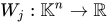



is a valuation which is homogeneous of degree that is,



Statement
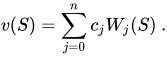
editAny continuous valuation on that is invariant under rigid motions can be represented as

Corollary
editAny continuous valuation on that is invariant under rigid motions and homogeneous of degree is a multiple of


See also
edit- Minkowski functional – Function made from a set
- Set function – Function from sets to numbers
References
editAn account and a proof of Hadwiger's theorem may be found in
- Klain, D.A.; Rota, G.-C. (1997). Introduction to geometric probability. Cambridge: Cambridge University Press. ISBN 0-521-59362-X. MR 1608265.
An elementary and self-contained proof was given by Beifang Chen in
- Chen, B. (2004). "A simplified elementary proof of Hadwiger's volume theorem". Geom. Dedicata. 105: 107–120. doi:10.1023/b:geom.0000024665.02286.46. MR 2057247.
