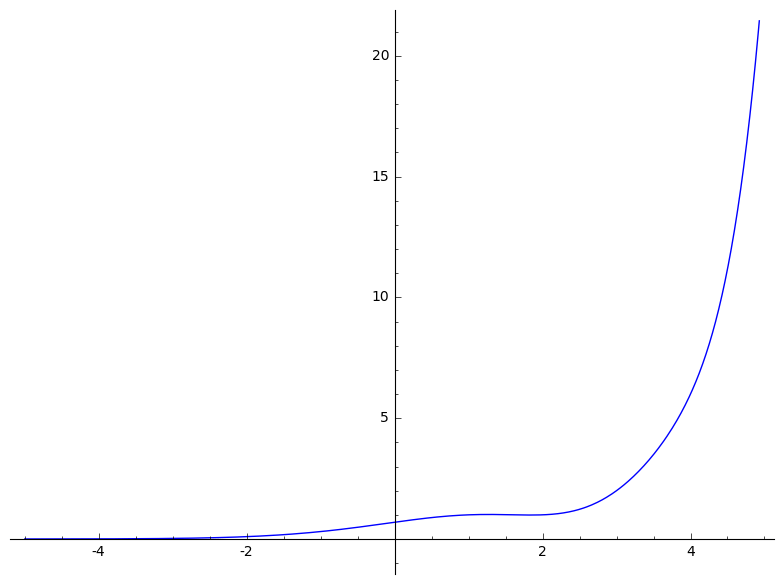
In mathematics, Hadamard's gamma function, named after Jacques Hadamard, is an extension of the factorial function, different from the classical gamma function (it is an instance of a pseudogamma function). This function, with its argument shifted down by 1, interpolates the factorial and extends it to real and complex numbers in a different way from Euler's gamma function. It is defined as:

where Γ(x) denotes the classical gamma function. If n is a positive integer, then:

Properties
editUnlike the classical gamma function, Hadamard's gamma function H(x) is an entire function, i.e., it is defined and analytic at all complex numbers. It satisfies the functional equation

with the understanding that is taken to be 0 for positive integer values of x.

The Hadamard's gamma function has a superadditive property:

for all , where is the unique solution to the equation in the interval .[1]


Representations
editHadamard's gamma can also be expressed as

and also as
![{\displaystyle H(x)=\Gamma (x)\left[1+{\frac {\sin(\pi x)}{2\pi }}\left\{\psi \left({\dfrac {x}{2}}\right)-\psi \left({\dfrac {x+1}{2}}\right)\right\}\right],}](https://wikimedia.org/api/rest_v1/media/math/render/svg/c9881a5068931a0b8b16c27f16787824d4dadb1c)
where ψ(x) denotes the digamma function, and denotes the Lerch zeta function.

See also
editReferences
edit- ^ Alzer, Horst (January 8, 2009). "A superadditive property of Hadamard's gamma function". Abhandlungen aus dem Mathematischen Seminar der Universität Hamburg. 79: 11–23. doi:10.1007/s12188-008-0009-5. Retrieved November 18, 2025.
- Hadamard, M. J. (1894), Sur L'Expression Du Produit 1·2·3· · · · ·(n−1) Par Une Fonction Entière (PDF) (in French), Œuvres de Jacques Hadamard, Centre National de la Recherche Scientifiques, Paris, 1968
- Srivastava, H. M.; Junesang, Choi (2012). Zeta and Q-Zeta Functions and Associated Series and Integrals. Elsevier insights. p. 124. ISBN 978-0-12-385218-2.
- "Introduction to the Gamma Function". The Wolfram Functions Site. Wolfram Research, Inc. Retrieved 27 February 2016.
