

In graph theory, a graceful labeling of a graph with m edges is a labeling of its vertices with some subset of the integers from 0 to m inclusive, such that no two vertices share a label, and each edge is uniquely identified by the absolute difference between its endpoints, such that this magnitude lies between 1 and m inclusive.[1] A graph which admits a graceful labeling is called a graceful graph.
The name "graceful labeling" is due to Solomon W. Golomb; this type of labeling was originally given the name β-labeling by Alexander Rosa in a 1967 paper on graph labelings.[2]
A major open problem in graph theory is the graceful tree conjecture or Ringel–Kotzig conjecture, named after Gerhard Ringel and Anton Kotzig, and sometimes abbreviated GTC (not to be confused with Kotzig's conjecture on regularly path connected graphs).[3] It hypothesizes that all trees are graceful. It is still an open conjecture, although a related but weaker conjecture known as "Ringel's conjecture" was partially proven in 2020.[4][5][6] Kotzig once called the effort to prove the conjecture a "disease".[7]
Another weaker version of graceful labelling is near-graceful labeling, in which the vertices can be labeled using some subset of the integers on [0, m + 1] such that no two vertices share a label, and each edge is uniquely identified by the absolute difference between its endpoints (this magnitude lies on [1, m + 1]).
Another conjecture in graph theory is Rosa's conjecture, named after Alexander Rosa, which says that all triangular cacti are graceful or nearly-graceful.[8]
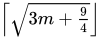
A graceful graph with edges 0 to m is conjectured to have no fewer than vertices, due to sparse ruler results. This conjecture has been verified for all graphs with 213 or fewer edges. A related conjecture is that the smallest 2m-valence graceful graph has edges, with the case for 6-valence shown below.


Selected results
edit- In his original paper, Rosa proved that an Eulerian graph with number of edges m ≡ 1 (mod 4) or m ≡ 2 (mod 4) cannot be graceful.[2]
- Also in his original paper, Rosa proved that the cycle Cn is graceful if and only if n ≡ 0 (mod 4) or n ≡ 3 (mod 4).
- All path graphs and caterpillar graphs are graceful.[2]
- All lobster graphs with a perfect matching are graceful.[9]
- All trees with at most 27 vertices are graceful; this result was shown by Aldred and McKay in 1998 using a computer program.[10][11] This was extended to trees with at most 29 vertices in the Honours thesis of Michael Horton.[12] Another extension of this result up to trees with 35 vertices was claimed in 2010 by the Graceful Tree Verification Project, a distributed computing project led by Wenjie Fang.[13]
- All wheel graphs, web graphs, helm graphs, gear graphs, and rectangular grids are graceful.[10]
- All n-dimensional hypercubes are graceful.[14]
- All simple connected graphs with four or fewer vertices are graceful. The only non-graceful simple connected graphs with five vertices are the 5-cycle (pentagon); the complete graph K5; and the butterfly graph.[15]
See also
editReferences
edit- ^ Virginia Vassilevska, "Coding and Graceful Labeling of trees." SURF 2001. PostScript
- ^ a b c Rosa, A. (1967), "On certain valuations of the vertices of a graph", Theory of Graphs (Internat. Sympos., Rome, 1966), New York: Gordon and Breach, pp. 349–355, MR 0223271.
- ^ Wang, Tao-Ming; Yang, Cheng-Chang; Hsu, Lih-Hsing; Cheng, Eddie (2015), "Infinitely many equivalent versions of the graceful tree conjecture", Applicable Analysis and Discrete Mathematics, 9 (1): 1–12, doi:10.2298/AADM141009017W, MR 3362693
- ^ Montgomery, Richard; Pokrovskiy, Alexey; Sudakov, Benny (2020). "A proof of Ringel's Conjecture". arXiv:2001.02665 [math.CO].
- ^ Huang, C.; Kotzig, A.; Rosa, A. (1982), "Further results on tree labellings", Utilitas Mathematica, 21: 31–48, MR 0668845.
- ^ Hartnett, Kevin (19 February 2020). "Rainbow Proof Shows Graphs Have Uniform Parts". Quanta Magazine. Retrieved 2020-02-29.
- ^ Huang, C.; Kotzig, A.; Rosa, A. (1982), "Further results on tree labellings", Utilitas Mathematica, 21: 31–48, MR 0668845.
- ^ Rosa, A. (1988), "Cyclic Steiner Triple Systems and Labelings of Triangular Cacti", Scientia, 1: 87–95.
- ^ Morgan, David (2008), "All lobsters with perfect matchings are graceful", Bulletin of the Institute of Combinatorics and Its Applications, 53: 82–85, hdl:10402/era.26923.
- ^ a b Gallian, Joseph A. (1998), "A dynamic survey of graph labeling", Electronic Journal of Combinatorics, 5: Dynamic Survey 6, 43 pp. (389 pp. in 18th ed.) (electronic), MR 1668059.
- ^ Aldred, R. E. L.; McKay, Brendan D. (1998), "Graceful and harmonious labellings of trees", Bulletin of the Institute of Combinatorics and Its Applications, 23: 69–72, MR 1621760.
- ^ Horton, Michael P. (2003), Graceful Trees: Statistics and Algorithms, University of Tasmania, doi:10.25959/23212346.v1.
- ^ Fang, Wenjie (2010), A Computational Approach to the Graceful Tree Conjecture, arXiv:1003.3045, Bibcode:2010arXiv1003.3045F. See also Graceful Tree Verification Project
- ^ Kotzig, Anton (1981), "Decompositions of complete graphs into isomorphic cubes", Journal of Combinatorial Theory, Series B, 31 (3): 292–296, doi:10.1016/0095-8956(81)90031-9, MR 0638285.
- ^ Weisstein, Eric W. "Graceful graph". MathWorld.
External links
editFurther reading
edit- (K. Eshghi) Introduction to Graceful Graphs, Sharif University of Technology, 2002.
- (U. N. Deshmukh and Vasanti N. Bhat-Nayak), New families of graceful banana trees – Proceedings Mathematical Sciences, 1996 – Springer
- (M. Haviar, M. Ivaska), Vertex Labellings of Simple Graphs, Research and Exposition in Mathematics, Volume 34, 2015.
- (Ping Zhang), A Kaleidoscopic View of Graph Colorings, SpringerBriefs in Mathematics, 2016 – Springer

