In mathematics, a complete manifold (or geodesically complete manifold) M is a (pseudo-) Riemannian manifold for which, starting at any point p of M, there are straight paths extending infinitely in all directions.
Formally, a manifold is (geodesically) complete if for any maximal geodesic , it holds that .[1] A geodesic is maximal if its domain cannot be extended.


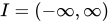
Equivalently, is (geodesically) complete if for all points , the exponential map at is defined on , the entire tangent space at .[1]


Hopf–Rinow theorem
editThe Hopf–Rinow theorem gives alternative characterizations of completeness. Let be a connected Riemannian manifold and let be its Riemannian distance function.


The Hopf–Rinow theorem states that is (geodesically) complete if and only if it satisfies one of the following equivalent conditions:[2]
- The metric space is complete (every -Cauchy sequence converges),
- All closed and bounded subsets of are compact.


Examples and non-examples
editEuclidean space , the sphere , and the tori (with their natural Riemannian metrics) are all complete manifolds.


All compact Riemannian manifolds and all homogeneous manifolds are geodesically complete. All symmetric spaces are geodesically complete.
Non-examples
edit


A simple example of a non-complete manifold is given by the punctured plane (with its induced metric). Geodesics going to the origin cannot be defined on the entire real line. By the Hopf–Rinow theorem, we can alternatively observe that it is not a complete metric space: any sequence in the plane converging to the origin is a non-converging Cauchy sequence in the punctured plane.

There exist non-geodesically complete compact pseudo-Riemannian (but not Riemannian) manifolds. An example of this is the Clifton–Pohl torus.
In the theory of general relativity, which describes gravity in terms of a pseudo-Riemannian geometry, many important examples of geodesically incomplete spaces arise, e.g. non-rotating uncharged black-holes or cosmologies with a Big Bang. The fact that such incompleteness is fairly generic in general relativity is shown in the Penrose–Hawking singularity theorems.
Extendibility
editIf is geodesically complete, then it is not isometric to an open proper submanifold of any other Riemannian manifold. The converse does not hold.[3][further explanation needed]
References
editNotes
edit- ^ a b Lee 2018, p. 131
- ^ do Carmo 1992, pp. 146–147
- ^ do Carmo 1992, p. 145
Sources
edit- do Carmo, Manfredo Perdigão (1992), Riemannian geometry, Mathematics: theory and applications, Boston: Birkhäuser, pp. xvi+300, ISBN 0-8176-3490-8
- Lee, John (2018). Introduction to Riemannian Manifolds. Graduate Texts in Mathematics. Springer International Publishing AG.
- O'Neill, Barrett (1983). Semi-Riemannian Geometry. Academic Press. Chapter 3. ISBN 0-12-526740-1.
