In coding theory, generalized minimum-distance (GMD) decoding provides an efficient algorithm for decoding concatenated codes, which is based on using an errors-and-erasures decoder for the outer code.
A naive decoding algorithm for concatenated codes can not be an optimal way of decoding because it does not take into account the information that maximum likelihood decoding (MLD) gives. In other words, in the naive algorithm, inner received codewords are treated the same regardless of the difference between their hamming distances. Intuitively, the outer decoder should place higher confidence in symbols whose inner encodings are close to the received word. David Forney in 1966 devised a better algorithm called generalized minimum distance (GMD) decoding which makes use of those information better. This method is achieved by measuring confidence of each received codeword, and erasing symbols whose confidence is below a desired value. And GMD decoding algorithm was one of the first examples of soft-decision decoders. We will present three versions of the GMD decoding algorithm. The first two will be randomized algorithms while the last one will be a deterministic algorithm.
Setup
edit
- Hamming distance : Given two vectors
 the Hamming distance between
  and
and  , denoted by
  , is defined to be the number of positions in which and differ.
- Minimum distance: Let
 be a code. The minimum distance of code
  is defined to be
  where
where 
- Code concatenation: Given
![{\displaystyle m=(m_{1},\cdots ,m_{K})\in [Q]^{K}}](https://wikimedia.org/api/rest_v1/media/math/render/svg/beebc5268b4378e4c3b142da1d861b22f98f34ba) , consider two codes which we call outer code and inner code
, consider two codes which we call outer code and inner code
![{\displaystyle C_{\text{out}}=[Q]^{K}\to [Q]^{N},\qquad C_{\text{in}}:[q]^{k}\to [q]^{n},}](https://wikimedia.org/api/rest_v1/media/math/render/svg/7b432223854f52245cf6ae62bd998f8a6daea11f)
- and their distances are
 and
and  . A concatenated code can be achieved by
  where
where  Finally we will take
  to be RS code, which has an errors and erasure decoder, and
 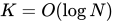 , which in turn implies that MLD on the inner code will be polynomial in
  time.
time.
- Maximum likelihood decoding (MLD): MLD is a decoding method for error correcting codes, which outputs the codeword closest to the received word in Hamming distance. The MLD function denoted by
 is defined as follows. For every
  .
.
- Probability density function : A probability distribution
 on a sample space
  is a mapping from events of to real numbers such that
 ![{\displaystyle \Pr[A]\geq 0}](https://wikimedia.org/api/rest_v1/media/math/render/svg/6288934954082f698bf416ec2e02012076bb8201) for any event
for any event ![{\displaystyle A,\Pr[S]=1}](https://wikimedia.org/api/rest_v1/media/math/render/svg/e0d0a40d7ab301d922bb23a4aab02f35c561b0bf) , and
, and ![{\displaystyle \Pr[A\cup B]=\Pr[A]+\Pr[B]}](https://wikimedia.org/api/rest_v1/media/math/render/svg/e6ee60e15bc1b75b8cfc8aab87dc4b4782ea148a) for any two mutually exclusive events
for any two mutually exclusive events  and
and 
- Expected value: The expected value of a discrete random variable
 is
is
![{\displaystyle \mathbb {E} [X]=\sum _{x}\Pr[X=x].}](https://wikimedia.org/api/rest_v1/media/math/render/svg/2b00b4c96e658352175021ec4aad62193c660043)
Randomized algorithm
edit
Consider the received word ![{\displaystyle \mathbf {y} =(y_{1},\ldots ,y_{N})\in [q^{n}]^{N}}](https://wikimedia.org/api/rest_v1/media/math/render/svg/2ea19682e7b48cc1eed64ce84618339e1cc1dbc3) which was corrupted by a noisy channel. The following is the algorithm description for the general case. In this algorithm, we can decode y by just declaring an erasure at every bad position and running the errors and erasure decoding algorithm for on the resulting vector.
which was corrupted by a noisy channel. The following is the algorithm description for the general case. In this algorithm, we can decode y by just declaring an erasure at every bad position and running the errors and erasure decoding algorithm for on the resulting vector.
Randomized_Decoder
Given : ![{\displaystyle \mathbf {y} =(y_{1},\dots ,y_{N})\in [q^{n}]^{N}}](https://wikimedia.org/api/rest_v1/media/math/render/svg/6ffdf051ef56d3a7862b02ebf301a89119320f1f) .
.
- For every
 , compute
  .
.
- Set
 .
.
- For every , repeat : With probability
 , set
, set  otherwise set
  .
.
- Run errors and erasure algorithm for on
 .
.
Theorem 1. Let y be a received word such that there exists a codeword ![{\displaystyle \mathbf {c} =(c_{1},\cdots ,c_{N})\in C_{\text{out}}\circ {C_{\text{in}}}\subseteq [q^{n}]^{N}}](https://wikimedia.org/api/rest_v1/media/math/render/svg/e490424b04ef05f869fdb5714b6a81a3ee4371a3) such that
such that 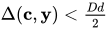 . Then the deterministic GMD algorithm outputs
  .
.
Note that a naive decoding algorithm for concatenated codes can correct up to  errors.
- Lemma 1. Let the assumption in Theorem 1 hold. And if
 has
has  errors and
  erasures (when compared with ) after Step 1, then
 ![{\displaystyle \mathbb {E} [2e'+s']<D.}](https://wikimedia.org/api/rest_v1/media/math/render/svg/504bbe8ae8fbbd701e22fdc916b9da981a3d91c7)
Remark. If 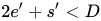 , then the algorithm in Step 2 will output . The lemma above says that in expectation, this is indeed the case. Note that this is not enough to prove Theorem 1, but can be crucial in developing future variations of the algorithm.
Proof of lemma 1. For every  define
 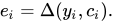 This implies that
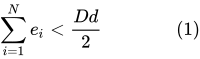 Next for every , we define two indicator variables:
 We claim that we are done if we can show that for every :
![{\displaystyle \mathbb {E} \left[2X{_{i}^{e}+X{_{i}^{?}}}\right]\leqslant {2e_{i} \over d}\qquad \qquad (2)}](https://wikimedia.org/api/rest_v1/media/math/render/svg/d09d9176c1bb6b75094d45a08321f43f45e3e1b1) Clearly, by definition
Clearly, by definition
 Further, by the linearity of expectation, we get
![{\displaystyle \mathbb {E} [2e'+s']\leqslant {\frac {2}{d}}\sum _{i}e_{i}<D.}](https://wikimedia.org/api/rest_v1/media/math/render/svg/d7e4931ada8a1d83525a61402aa965de4c55ce20) To prove (2) we consider two cases:
To prove (2) we consider two cases:  -th block is correctly decoded (Case 1), -th block is incorrectly decoded (Case 2):
Case 1: 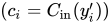
Note that if  then
then  , and
, and ![{\displaystyle \Pr[y_{i}''=?]={\tfrac {2\omega _{i}}{d}}}](https://wikimedia.org/api/rest_v1/media/math/render/svg/6fb95b0b12a259213e11afbab1653625b6a546dd) implies
implies ![{\displaystyle \mathbb {E} [X_{i}^{?}]=\Pr[X_{i}^{?}=1]={\tfrac {2\omega _{i}}{d}},}](https://wikimedia.org/api/rest_v1/media/math/render/svg/7b8ba82f10513d556e247f949524456c52c27f6b) and
and ![{\displaystyle \mathbb {E} [X_{i}^{e}]=\Pr[X_{i}^{e}=1]=0}](https://wikimedia.org/api/rest_v1/media/math/render/svg/2140e574d338b5c0a6d539e5f7e93d8ec5d685df) .
.
Further, by definition we have
 Case 2: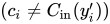
In this case, ![{\displaystyle \mathbb {E} [X_{i}^{?}]={\tfrac {2\omega _{i}}{d}}}](https://wikimedia.org/api/rest_v1/media/math/render/svg/ab481e0b4b4df0089746e87cb2d881505a0e890b) and
and ![{\displaystyle \mathbb {E} [X_{i}^{e}]=\Pr[X_{i}^{e}=1]=1-{\tfrac {2\omega _{i}}{d}}.}](https://wikimedia.org/api/rest_v1/media/math/render/svg/618724c3e59f7524419397d248965e589155e8d7)
Since  . This follows another case analysis[1] when
  or not.
Finally, this implies
![{\displaystyle \mathbb {E} [2X_{i}^{e}+X_{i}^{?}]=2-{2\omega _{i} \over d}\leq {2e_{i} \over d}.}](https://wikimedia.org/api/rest_v1/media/math/render/svg/45938919c2824e5ec5e155b3b72ee202f376f196) In the following sections, we will finally show that the deterministic version of the algorithm above can do unique decoding of
In the following sections, we will finally show that the deterministic version of the algorithm above can do unique decoding of  up to half its design distance.
Modified randomized algorithm
edit
Note that, in the previous version of the GMD algorithm in step "3", we do not really need to use "fresh" randomness for each . Now we come up with another randomized version of the GMD algorithm that uses the same randomness for every . This idea follows the algorithm below.
Modified_Randomized_Decoder
Given : , pick ![{\displaystyle \theta \in [0,1]}](https://wikimedia.org/api/rest_v1/media/math/render/svg/fead1e7dceab4be5ab2e91f5108144722daa8c36) at random. Then every for every :
at random. Then every for every :
- Set .
- Compute
 .
.
- If
 , set otherwise set .
- Run errors and erasure algorithm for on .
For the proof of Lemma 1, we only use the randomness to show that
![{\displaystyle \Pr[y_{i}''=?]={2\omega _{i} \over d}.}](https://wikimedia.org/api/rest_v1/media/math/render/svg/ed2d021f200168a3f20c7d02c862efcc63ba53b7) In this version of the GMD algorithm, we note that
In this version of the GMD algorithm, we note that
![{\displaystyle \Pr[y_{i}''=?]=\Pr \left[\theta \in \left[0,{\tfrac {2\omega _{i}}{d}}\right]\right]={\tfrac {2\omega _{i}}{d}}.}](https://wikimedia.org/api/rest_v1/media/math/render/svg/69c7751c430d0b26267c38f4115acc0a3508de16) The second equality above follows from the choice of
The second equality above follows from the choice of  . The proof of Lemma 1 can be also used to show
 ![{\displaystyle \mathbb {E} [2e'+s']<D}](https://wikimedia.org/api/rest_v1/media/math/render/svg/419492596494760f9ea47ab39b9206dfbe33679c) for version2 of GMD. In the next section, we will see how to get a deterministic version of the GMD algorithm by choosing from a polynomially sized set as opposed to the current infinite set
for version2 of GMD. In the next section, we will see how to get a deterministic version of the GMD algorithm by choosing from a polynomially sized set as opposed to the current infinite set ![{\displaystyle [0,1]}](https://wikimedia.org/api/rest_v1/media/math/render/svg/738f7d23bb2d9642bab520020873cccbef49768d) .
.
Deterministic algorithm
edit
Let  . Since for each
 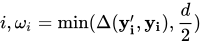 , we have
 where
where  for some
  . Note that for every
 ![{\displaystyle \theta \in [q_{i},q_{i+1}]}](https://wikimedia.org/api/rest_v1/media/math/render/svg/817aa31ed3131d36737531dacc009f27c8e20e1f) , the step 1 of the second version of randomized algorithm outputs the same
, the step 1 of the second version of randomized algorithm outputs the same  . Thus, we need to consider all possible value of
  . This gives the deterministic algorithm below.
Deterministic_Decoder
Given : , for every , repeat the following.
- Compute for .
- Set for every .
- If
 , set otherwise set .
- Run errors-and-erasures algorithm for on . Let
 be the codeword in corresponding to the output of the algorithm, if any.
- Among all the output in 4, output the one closest to

Every loop of 1~4 can be run in polynomial time, the algorithm above can also be computed in polynomial time. Specifically, each call to an errors and erasures decoder of  errors takes
  time. Finally, the runtime of the algorithm above is
  where
where  is the running time of the outer errors and erasures decoder.
See also
edit
References
edit
