In mathematics, a filter on a set  informally gives a notion of which subsets
  are "large". Filter quantifiers are a type of logical quantifier which, informally, say whether or not a statement is true for "most" elements of
  Such quantifiers are often used in combinatorics, model theory (such as when dealing with ultraproducts), and in other fields of mathematical logic where (ultra)filters are used.
Background
edit
Here we will use the set theory convention, where a filter  on a set is defined to be an order-theoretic proper filter in the poset
  that is, a subset of
  such that:
 and
and  ;
;- For all
 we have
  ;
;
- For all
 if
if  then
then 
Recall a filter on is an ultrafilter if, for every  either or
Given a filter on a set  we say a subset is -stationary if, for all
  we have
  [1]
[1]
Definition
edit
Let be a filter on a set We define the filter quantifiers  and
and  as formal logical symbols with the following interpretation:

 is -stationary
for every first-order formula  with one free variable. These also admit alternative definitions as


When is an ultrafilter, the two quantifiers defined above coincide, and we will often use the notation  instead. Verbally, we might pronounce as "for -almost all
  ", "for -most ", "for the majority of (according to )", or "for most (according to )". In cases where the filter is clear, we might omit mention of
Properties
edit
The filter quantifiers and satisfy the following logical identities,[1] for all formulae  :
:
- Duality:

- Weakening:

- Conjunction:


- Disjunction:


- If
 are filters on then:


Additionally, if is an ultrafilter, the two filter quantifiers coincide:  [citation needed] Renaming this quantifier
  the following properties hold:
- Negation:

- Weakening:

- Conjunction:

- Disjunction:

In general, filter quantifiers do not commute with each other, nor with the usual  and
and  quantifiers.[citation needed]
Examples
edit
- If
 is the trivial filter on then unpacking the definition, we have
  and
and  This recovers the usual and quantifiers.
- Let
 be the Fréchet filter on an infinite set Then,
  holds iff holds for cofinitely many
  and
and  holds iff holds for infinitely many
  The quantifiers
  and
and  are more commonly denoted
  and
and  respectively.
- Let
 be the "measure filter" on
 ![{\displaystyle [0,1],}](https://wikimedia.org/api/rest_v1/media/math/render/svg/971caee396752d8bf56711f55d2c3b1207d4a236) generated by all subsets
generated by all subsets ![{\displaystyle A\subseteq [0,1]}](https://wikimedia.org/api/rest_v1/media/math/render/svg/8e3d8de430d45afa5c39b772e605c957117e8435) with Lebesgue measure
with Lebesgue measure  The above construction gives us "measure quantifiers":
  holds iff holds almost everywhere, and
  holds iff holds on a set of positive measure.[2]
- Suppose
 is the principal filter on some set
  Then, we have
  and
and 
- If
 is the principal ultrafilter of an element
  then we have
Use
edit
The utility of filter quantifiers is that they often give a more concise or clear way to express certain mathematical ideas. For example, take the definition of convergence of a real-valued sequence: a sequence 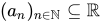 converges to a point
  if
if

Using the Fréchet quantifier as defined above, we can give a nicer (equivalent) definition:

Filter quantifiers are especially useful in constructions involving filters. As an example, suppose that has a binary operation  defined on it. There is a natural way to extend[3] to
  the set of ultrafilters on :[4]

With an understanding of the ultrafilter quantifier, this definition is reasonably intuitive. It says that  is the collection of subsets such that, for most (according to
  ) and for most
  (according to
  ), the sum
  is in
is in  Compare this to the equivalent definition without ultrafilter quantifiers:

The meaning of this is much less clear.
This increased intuition is also evident in proofs involving ultrafilters. For example, if is associative on using the first definition of  it trivially follows that
  is associative on
  Proving this using the second definition takes a lot more work.[5]
See also
edit
References
edit



