This article needs additional citations for verification. (April 2026) |


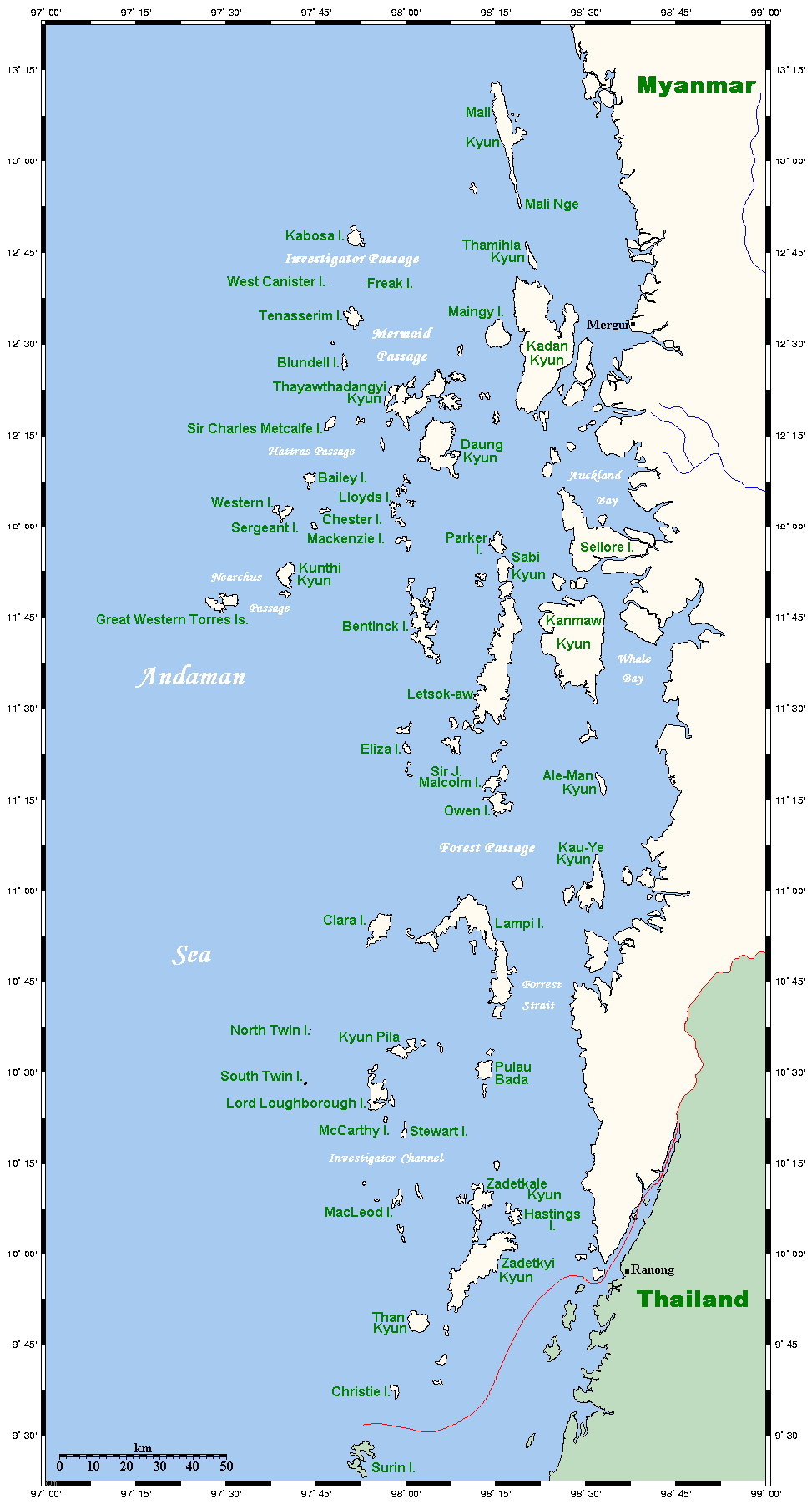
An archipelago (/ˌɑːrkəˈpɛləɡoʊ/ ⓘ AR-kə-PEL-ə-goh),[1] sometimes called an island group or island chain, is a chain, cluster, or collection of islands. An archipelago may be in an ocean, a sea, or a smaller body of water. The largest archipelago country in the world is Indonesia, whose territory comprises most of the Indonesian Archipelago. Examples of archipelagos include the Aegean Islands (the origin of the term archipelago), the Canadian Arctic Archipelago, the Stockholm Archipelago, the Lucayan (Bahamian) Archipelago, the Japanese archipelago, the Hawaiian Archipelago, and the Galapagos.
Etymology
editThe word archipelago is derived from the Italian arcipelago (used as a proper name for the Aegean Sea), itself perhaps a deformation of the Greek Αιγαίον Πέλαγος.[2][3] Usage later shifted to refer to the Aegean Islands (since the sea has a large number of islands). The erudite paretymology, deriving the word from Ancient Greek ἄρχι- (arkhi-, "chief") and πέλαγος (pélagos, "sea"), proposed by Buondelmonti, can still be found.[4]
Geographic types
editArchipelagos may be found isolated in large bodies of water or neighboring a large land mass. For example, Scotland has more than 700 islands surrounding its mainland, which form an archipelago.[citation needed]
Depending on their geological origin, islands forming archipelagos can be referred to as oceanic islands, continental fragments, or continental islands.[5]
Oceanic islands
editOceanic islands are formed by volcanoes erupting from the ocean floor. The Hawaiian Islands and Galapagos Islands in the Pacific, and Mascarene Islands in the south Indian Ocean are examples.[citation needed]
Continental fragments
editContinental fragments are islands that were once part of a continent, and became separated due to natural disasters. The fragments may also be formed by moving glaciers which cut out land, which then fills with water. The Farallon Islands off the coast of California are examples of continental fragment islands.[citation needed]
Coral cay archipelago
editA coral cay archipelago is formed when ocean currents transport sediments that gradually build up on coral reefs. The Florida Keys are one example.[6]
Continental islands
edit
Continental islands are islands that were once part of a continent and still sit on the continental shelf, which is the edge of a continent that lies under the ocean. The islands of the Inside Passage off the coast of British Columbia and the Canadian Arctic Archipelago are examples.[citation needed]
Artificial archipelagos
editArtificial archipelagos have been created in various countries for different purposes. Palm Islands and The World Islands in Dubai were or are being created for leisure and tourism purposes.[7][8] Marker Wadden in the Netherlands is being built as a conservation area for birds and other wildlife.[9]
Superlatives
editThe largest archipelago in the world by number of islands is the Archipelago Sea, which is part of Finland. There are approximately 40,000 islands, most being uninhabited.[10] The largest archipelagic state in the world by area with more than 17,500 islands,[11] and by population of around 284 million people,[12] is Indonesia.[13]
See also
edit

- List of landforms
- List of archipelagos by number of islands
- List of archipelagos
- Archipelagic state
- List of islands
- Aquapelago
References
edit- ^ "archipelago". Dictionary.com Unabridged (Online). n.d.
- ^ "archipelago". Dictionary.com Unabridged (Online). n.d.
- ^ Oxford English Dictionary, s.v. "archipelago (n.), Etymology", July 2023, [1]
- ^ Maltézou, Chryssa A., De la mer Égée à l'archipel: quelques remarques sur l'histoire insulaire égéenne In: Mélanges Hélène Ahrweiler Pt. 2 (1998) p. 464–465
- ^ Whittaker R. J. & Fernández-Palacios J. M. (2007) Island Biogeography: Ecology, Evolution, and Conservation. New York, Oxford University Press
- ^ US Department of Commerce, National Oceanic and Atmospheric Administration. "What is an archipelago?". oceanservice.noaa.gov. Retrieved 24 November 2025.
- ^ McFadden, Christopher (22 December 2019). "7+ Amazing Facts About Dubai's Palm Islands". Interesting Engineering. Archived from the original on 28 May 2022. Retrieved 8 July 2020.
- ^ Wainwright, Oliver (13 February 2018). "Not the end of The World: the return of Dubai's ultimate folly". The Guardian. Archived from the original on 17 August 2025. Retrieved 8 July 2020.
- ^ Boffey, Daniel (27 April 2019). "Marker Wadden, the manmade Dutch archipelago where wild birds reign supreme". The Guardian. Archived from the original on 10 January 2026. Retrieved 8 July 2020.
- ^ "Nautical chart: International no. 1205, SE61, Baltic Sea, North, Sea of Åland" (PDF). Archived from the original (PDF) on 20 October 2017. Retrieved 16 March 2023.
- ^ "Indonesia at a glance". FAO. Retrieved 4 March 2026.
- ^ "Mid Year Population - Statistical Data". www.bps.go.id. Statistics Indonesia. Retrieved 4 March 2026.
- ^ "Indonesia". The World Factbook (2008 ed.). Central Intelligence Agency. Retrieved 7 December 2008.
External links
edit

- Chisholm, Hugh, ed. (1911). . Encyclopædia Britannica (11th ed.). Cambridge University Press.
- 30 Most Incredible Island Archipelagos
