In relational database theory, an equality-generating dependency (EGD) is a certain kind of constraint on data. It is a subclass of the class of embedded dependencies (ED).
An algorithm known as the chase takes as input an instance that may or may not satisfy a set of EGDs (or, more generally, a set of EDs), and, if it terminates (which is a priori undecidable), output an instance that does satisfy the EGDs.
An important subclass of equality-generating dependencies are functional dependencies.
Definition
editAn equality-generating dependency is a sentence in first-order logic of the form:

where , is a conjunction of relational and equality atoms and is a non-empty conjunction of equality atoms. A relational atom has the form and an equality atom has the form , where each of the terms are variables or constants.



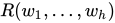


Actually, one can remove all equality atoms from the body of the dependency without loss of generality.[1] For instance, if the body consists in the conjunction , then it can be replaced with (analogously replacing possible occurrences of the variables and in the head).




An equivalent definition is the following:[2]

where . Indeed, generating a conjunction of equalities is equivalent to have multiple dependencies which generate only one equality.

References
edit- ^ (Abiteboul, Hull & Vianu 1995, p. 217)
- ^ Calì, Andrea; Pieris, Andreas (2011). On Equality-Generating Dependencies in Ontology Querying - Preliminary Report (PDF). Alberto Mendelzon International Workshop on Foundations of Data Management (AMW 2011).
Further reading
edit- Abiteboul, Serge; Hull, Richard B.; Vianu, Victor (1995). Foundations of Databases. Addison-Wesley. ISBN 0-201-53771-0.
- Alin Deutsch, FOL Modeling of Integrity Constraints, https://web.archive.org/web/20140912044956/http://db.ucsd.edu/pubsFileFolder/305.pdf
 | This database-related article is a stub. You can help Wikipedia by adding missing information. |
