In mathematics, Dirichlet's test is a method of testing for the convergence of a series that is especially useful for proving conditional convergence. It is named after its author Peter Gustav Lejeune Dirichlet, and was published posthumously in the Journal de Mathématiques Pures et Appliquées in 1862.[1]
Statement
editThe test states that if is a monotonic sequence of real numbers with and is a sequence of real numbers or complex numbers with bounded partial sums, then the series




Proof
editLet and .

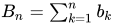
From summation by parts, we have that . Since the magnitudes of the partial sums are bounded by some M and as , the first of these terms approaches zero: as .



Furthermore, for each k, .

Since is monotone, it is either decreasing or increasing:
- If is decreasing, which is a telescoping sum that equals and therefore approaches as . Thus, converges.
- If is increasing, which is again a telescoping sum that equals and therefore approaches as . Thus, again, converges.

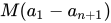





So, the series converges by the direct comparison test to . Hence converges.[2][4]


Applications
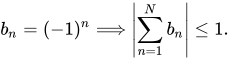
editA particular case of Dirichlet's test is the more commonly used alternating series test for the case[2][5]
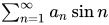
Another corollary is that converges whenever is a decreasing sequence that tends to zero. To see that is bounded, we can use the summation formula[6]


Improper integrals
editAn analogous statement for convergence of improper integrals is proven using integration by parts. If the integral of a function f is uniformly bounded over all intervals, and g is a bounded non-negative monotonically decreasing function, then the integral of fg is a convergent improper integral.
Notes
edit- ^ Démonstration d’un théorème d’Abel. Journal de mathématiques pures et appliquées 2nd series, tome 7 (1862), pp. 253–255 Archived 2011-07-21 at the Wayback Machine. See also [1].
- ^ a b c Apostol 1967, pp. 407–409
- ^ Spivak 2008, p. 495
- ^ a b Rudin 1976, p. 70
- ^ Rudin 1976, p. 71
- ^ "Where does the sum of $\sin(n)$ formula come from?".
References
edit- Apostol, Tom M. (1967) [1961]. Calculus. Vol. 1 (2nd ed.). John Wiley & Sons. ISBN 0-471-00005-1.
- Hardy, G. H., A Course of Pure Mathematics, Ninth edition, Cambridge University Press, 1946. (pp. 379–380).
- Rudin, Walter (1976) [1953]. Principles of mathematical analysis (3rd ed.). New York: McGraw-Hill. ISBN 0-07-054235-X. OCLC 1502474.
- Spivak, Michael (2008) [1967]. Calculus (4th ed.). Houston, TX: Publish or Perish. ISBN 978-0-914098-91-1.
- Voxman, William L., Advanced Calculus: An Introduction to Modern Analysis, Marcel Dekker, Inc., New York, 1981. (§8.B.13–15) ISBN 0-8247-6949-X.
