This article includes a list of references, related reading, or external links, but its sources remain unclear because it lacks inline citations. (October 2025) |
In mathematics – specifically, in operator theory – a densely defined operator or partially defined operator is a type of partially defined function. In a topological sense, it is a linear operator that is defined "almost everywhere". Densely defined operators often arise in functional analysis as operations that one would like to apply to a larger class of objects than those for which they a priori "make sense".[clarification needed]
A closed operator that is used in practice is often densely defined.
Definition
editLet be topological vector spaces.

A densely defined linear operator from to is a linear operator of type , such that is a dense subset of . In other words, is a partial function whose domain is dense in .


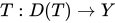

Sometimes this is abbreviated as when the context makes it clear that might not be defined for all of .

Properties
editClosed Graph Theorem—If are Hausdorff and metrizable, is densely defined, with continuous inverse , then is closed. That is, the set is closed in the product topology of .


Take any net in with in . By continuity of , . Hence there exists some such that , and .


The Hausdorff property ensures sequential convergence is unique. The metrizability property ensures that sequentially closed sets are closed. In functional analysis, these conditions typically hold, as most spaces under consideration are Fréchet space, or stronger than Fréchet. In particular, Banach spaces are Fréchet.
Examples
editSequence
editLet be the Hilbert space of square-summable sequences, with orthonormal basis . Define the diagonal operatorwith domainThen is dense in because the finitely supported sequences , and is dense in . The operator is closed and unbounded, since .


There exists a bounded inverse:Hence is bijective with bounded inverse, so and, by the Neumann series argument, the resolvent set of contains the open unit disk .


In fact, the spectrum of (that is, the complement of its resolvent set) is precisely the set of positive integers, since for any , the diagonal formula defines a bounded operator .


Thus, is a densely defined, closed, unbounded operator with bounded inverse and nontrivial, unbounded spectrum.
Differentiation
editConsider the space of all real-valued, continuous functions defined on the unit interval; let denote the subspace consisting of all continuously differentiable functions. Equip with the supremum norm ; this makes into a real Banach space. The differentiation operator given by is a linear operator defined on the dense linear subspace , therefore it is a operator densely defined on .
![{\displaystyle C^{0}([0,1];\mathbb {R} )}](https://wikimedia.org/api/rest_v1/media/math/render/svg/ccedd8a24359f5f622afaaf9f46736d2df5af286)
![{\displaystyle C^{1}([0,1];\mathbb {R} )}](https://wikimedia.org/api/rest_v1/media/math/render/svg/12d11c6f8df6d181b876963c4f1811ff3e59d3e1)



![{\displaystyle C^{1}([0,1];\mathbb {R} )\subset C^{0}([0,1];\mathbb {R} )}](https://wikimedia.org/api/rest_v1/media/math/render/svg/34d8b13b231830e8a74a24368cc55ab68303629f)
The operator is an example of an unbounded linear operator, since This unboundedness causes problems if one wishes to somehow continuously extend the differentiation operator to the whole of


![{\displaystyle C^{0}([0,1];\mathbb {R} ).}](https://wikimedia.org/api/rest_v1/media/math/render/svg/8ff1def4feff2289955003900394edfd4a054839)
Paley–Wiener
editThe Paley–Wiener integral is a standard example of a continuous extension of a densely defined operator.
In any abstract Wiener space with adjoint there is a natural continuous linear operator (in fact it is the inclusion, and is an isometry) from to under which goes to the equivalence class of in It can be shown that is dense in Since the above inclusion is continuous, there is a unique continuous linear extension of the inclusion to the whole of This extension is the Paley–Wiener map.





![{\displaystyle [f]}](https://wikimedia.org/api/rest_v1/media/math/render/svg/7414a730e8157655ff770265ec3a03ec9f09dd54)




See also
edit- Blumberg theorem – Any real function on R admits a continuous restriction on a dense subset of R
- Closed graph theorem (functional analysis) – Theorems connecting continuity to closure of graphs
- Linear extension (linear algebra) – Mathematical function, in linear algebra
- Partial function – Function whose actual domain of definition may be smaller than its apparent domain
References
edit- Renardy, Michael; Rogers, Robert C. (2004). An introduction to partial differential equations. Texts in Applied Mathematics 13 (Second ed.). New York: Springer-Verlag. pp. xiv+434. ISBN 0-387-00444-0. MR 2028503.
