In number theory, the Dedekind psi function is the multiplicative function on the positive integers defined by

where the product is taken over all primes dividing (By convention, , which is the empty product, has value 1.) The function was introduced by Richard Dedekind in connection with modular functions.


The value of for the first few positive integers is:


The function is greater than for all greater than 1, and is even for all greater than 2. If is a square-free number then , where is the sum-of-divisors function.


The function can also be defined by setting for powers of any prime , and then extending the definition to all integers by multiplicativity. This also leads to a proof of the generating function in terms of the Riemann zeta function, which is


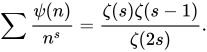
This is also a consequence of the fact that we can write the function as a Dirichlet convolution of .

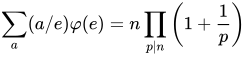
There is an additive definition of the psi function as well. Quoting from Dickson,[1]
R. Dedekind[2] proved that, if is decomposed in every way into a product and if is the g.c.d. of then
where ranges over all divisors of and over the prime divisors of and is the totient function.




Higher orders
editThe generalization to higher orders via ratios of Jordan's totient is

with Dirichlet series
- .

It is also the Dirichlet convolution of a power and the square of the Möbius function,
- .

If

is the characteristic function of the squares, another Dirichlet convolution leads to the generalized σ-function,
- .

References
editExternal links
editSee also
edit- Goro Shimura (1971). Introduction to the Arithmetic Theory of Automorphic Functions. Princeton. (page 25, equation (1))
- Mathar, Richard J. (2011). "Survey of Dirichlet series of multiplicative arithmetic functions". arXiv:1106.4038 [math.NT]. Section 3.13.2
- OEIS: A065958 is ψ2, OEIS: A065959 is ψ3, and OEIS: A065960 is ψ4
