A software component is a modular unit of software that encapsulates specific functionality.[1] The desired characteristics of a component are reusability and maintainability.[1]
Value
editComponents allow software developers to assemble software with reliable parts rather than writing code for every aspect. It makes implementation more like factory assembly than custom building.
Attributes
editDesirable attributes of a component include but are not limited to:
- Cohesive – encapsulates related functionality
- Substitutable – can be replaced by another component with the same interface
Third-party
editSome components are built in-house by the same organization or team building the software system. Some are third-party, developed elsewhere and assembled into the software system.[2]
Component-based software engineering
editFor large-scale systems, component-based development encourages a disciplined process to manage complexity.[3]
Framework
editSome components conform to a framework technology that allows them to be consumed in a well-known way. Examples include: CORBA, COM, Enterprise JavaBeans, and the .NET Framework.[4][5]
Modeling
edit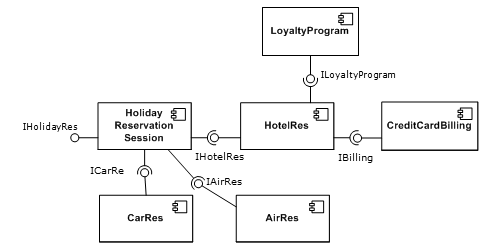
Component design is often modeled visually. In Unified Modeling Language (UML) 2.0 a component is shown as a rectangle, and an interface is shown as a lollipop to indicate a provided interface and as a socket to indicate consumption of an interface.
History
editThe idea of reusable software components was promoted by Douglas McIlroy in his presentation at the NATO Software Engineering Conference of 1968.[6] (One goal of that conference was to resolve the so-called software crisis of the time.) In the 1970s, McIlroy put this idea into practice with the addition of the pipeline feature to the Unix operating system.
Brad Cox refined the concept of a software component in the 1980s.[7] He attempted to create an infrastructure and market for reusable third-party components by inventing the Objective-C programming language.[8]
IBM introduced System Object Model (SOM) in the early 1990s.[9]
Microsoft introduced Component Object Model (COM) in the early 1990s. Microsoft built many domain-specific component technologies on COM, including Distributed Component Object Model (DCOM), Object Linking and Embedding (OLE), and ActiveX.
References
edit- ^ a b Pandey, Pankaj (11 July 2023). "Tutorial notes: Software Components and Connectors". medium.com. Retrieved 14 May 2024.
- ^ Yadav, Sunny (16 April 2024). "Types of Software Components — With Examples". LinkedIn. Retrieved 14 May 2024.
- ^ Douglas C. Schmidt. "Why Software Reuse has Failed and How to Make It Work for You". Retrieved 14 May 2024.
- ^ Crnkovic, I.; Sentilles, S.; Vulgarakis, A.; Chaudron, M. R. V. (2011). "A Classification Framework for Software Component Models". IEEE Transactions on Software Engineering. 37 (5): 593–615. doi:10.1109/TSE.2010.83. S2CID 15449138.
- ^ Lau, Kung-Kiu; Wang, Zheng (2007). "Software Component Models". IEEE Transactions on Software Engineering. 33 (10): 709–724. doi:10.1109/TSE.2007.70726. ISSN 0098-5589.
- ^ McIlroy, Malcolm Douglas (January 1969). "Mass produced software components" (PDF). Software Engineering: Report of a conference sponsored by the NATO Science Committee, Garmisch, Germany, 7-11 Oct. 1968. Scientific Affairs Division, NATO. p. 79.
- ^ Rainer Niekamp. "Software Component Architecture" (PDF). Gestión de Congresos - CIMNE/Institute for Scientific Computing, TU Braunschweig. p. 4. Archived from the original (PDF) on 2012-03-28. Retrieved 2011-07-29.
The modern concept of a software component largely defined by Brad Cox of Stepstone, => Objective-C programming language
- ^ Brad Cox (1991). Object Oriented Programming: An Evolutionary Approach. Addison Wesley. ISBN 0-201-54834-8.
- ^ Raphael Gfeller (December 9, 2008). "Upgrading of component-based application". HSR - Hochschule für Technik Rapperswill. p. 4. Retrieved 2011-07-29.
1990, IBM invents their System Object Model. 1990, as a reaction, Microsoft released OLE 1.0 OLE custom controls (OCX)
[permanent dead link]
