


In mathematics, especially in linear algebra and matrix theory, the commutation matrix is used for transforming the vectorized form of a matrix into the vectorized form of its transpose. Specifically, the commutation matrix K(m,n) is the nm × mn permutation matrix which, for any m × n matrix A, transforms vec(A) into vec(AT):
- K(m,n) vec(A) = vec(AT) .
Here vec(A) is the mn × 1 column vector obtain by stacking the columns of A on top of one another:
![{\displaystyle \operatorname {vec} (\mathbf {A} )=[\mathbf {A} _{1,1},\ldots ,\mathbf {A} _{m,1},\mathbf {A} _{1,2},\ldots ,\mathbf {A} _{m,2},\ldots ,\mathbf {A} _{1,n},\ldots ,\mathbf {A} _{m,n}]^{\mathrm {T} }}](https://wikimedia.org/api/rest_v1/media/math/render/svg/5539b06d5a44e39b44bd7fe46618c2754e2c7799)
where A = [Ai,j]. In other words, vec(A) is the vector obtained by vectorizing A in column-major order. Similarly, vec(AT) is the vector obtaining by vectorizing A in row-major order. The cycles and other properties of this permutation have been heavily studied for in-place matrix transposition algorithms.
In the context of quantum information theory, the commutation matrix is sometimes referred to as the swap matrix or swap operator [1]
Properties
edit- The commutation matrix is a special type of permutation matrix, and is therefore orthogonal. In particular, K(m,n) is equal to , where is the permutation over for which



- The determinant of K(m,n) is .
- Replacing A with AT in the definition of the commutation matrix shows that K(m,n) = (K(n,m))T. Therefore, in the special case of m = n the commutation matrix is an involution and symmetric.
- The main use of the commutation matrix, and the source of its name, is to commute the Kronecker product: for every m × n matrix A and every r × q matrix B,

- This property is often used in developing the higher order statistics of Wishart covariance matrices.[2]

- The case of n=q=1 for the above equation states that for any column vectors v,w of sizes m,r respectively,
- This property is the reason that this matrix is referred to as the "swap operator" in the context of quantum information theory.

- Two explicit forms for the commutation matrix are as follows: if er,j denotes the j-th canonical vector of dimension r (i.e. the vector with 1 in the j-th coordinate and 0 elsewhere) then

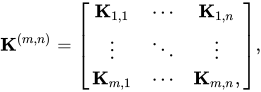
- The commutation matrix may be expressed as the following block matrix:
- Where the p,q entry of n x m block-matrix Ki,j is given by
- For example,

![{\displaystyle \mathbf {K} ^{(3,4)}=\left[{\begin{array}{ccc|ccc|ccc|ccc}1&0&0&0&0&0&0&0&0&0&0&0\\0&0&0&1&0&0&0&0&0&0&0&0\\0&0&0&0&0&0&1&0&0&0&0&0\\0&0&0&0&0&0&0&0&0&1&0&0\\\hline 0&1&0&0&0&0&0&0&0&0&0&0\\0&0&0&0&1&0&0&0&0&0&0&0\\0&0&0&0&0&0&0&1&0&0&0&0\\0&0&0&0&0&0&0&0&0&0&1&0\\\hline 0&0&1&0&0&0&0&0&0&0&0&0\\0&0&0&0&0&1&0&0&0&0&0&0\\0&0&0&0&0&0&0&0&1&0&0&0\\0&0&0&0&0&0&0&0&0&0&0&1\end{array}}\right].}](https://wikimedia.org/api/rest_v1/media/math/render/svg/6523041de4123197fb08708f8e7c16c058c04f8a)
Code
editFor both square and rectangular matrices of m rows and n columns, the commutation matrix can be generated by the code below.
Python
editimport numpy as np
def comm_mat(m, n):
# determine permutation applied by K
w = np.arange(m * n).reshape((m, n), order="F").T.ravel(order="F")
# apply this permutation to the rows (i.e. to each column) of identity matrix and return result
return np.eye(m * n)[w, :]
Alternatively, a version without imports:
# Kronecker delta
def delta(i, j):
    return int(i == j)

def comm_mat(m, n):
    # determine permutation applied by K
    v = [m * j + i for i in range(m) for j in range(n)]

    # apply this permutation to the rows (i.e. to each column) of identity matrix
    I = [[delta(i, j) for j in range(m * n)] for i in range(m * n)]
    return [I[i] for i in v]
MATLAB
editfunction P = com_mat(m, n)
% determine permutation applied by K
A = reshape(1:m*n, m, n);
v = reshape(A', 1, []);
% apply this permutation to the rows (i.e. to each column) of identity matrix
P = eye(m*n);
P = P(v,:);
R
edit# Sparse matrix version
comm_mat = function(m, n){
i = 1:(m * n)
j = NULL
for (k in 1:m) {
j = c(j, m * 0:(n-1) + k)
}
Matrix::sparseMatrix(
i = i, j = j, x = 1
)
}
Example
editLet denote the following matrix:

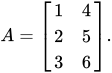
has the following column-major and row-major vectorizations (respectively):
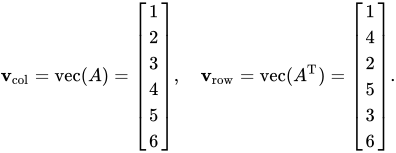
The associated commutation matrix is
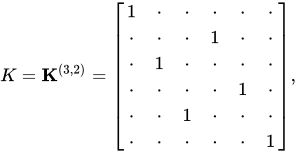
(where each denotes a zero). As expected, the following holds:



References
edit- ^ Watrous, John (2018). The Theory of Quantum Information. Cambridge University Press. p. 94.
- ^ von Rosen, Dietrich (1988). "Moments for the Inverted Wishart Distribution". Scand. J. Stat. 15: 97–109.
- Jan R. Magnus and Heinz Neudecker (1988), Matrix Differential Calculus with Applications in Statistics and Econometrics, Wiley.
