It generalizes to more than just Chebyshev polynomials; it applies to any class of functions that can be defined by a three-term recurrence relation.[3]
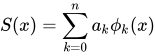
In full generality, the Clenshaw algorithm computes the weighted sum of a finite series of functions :
where is a sequence of functions that satisfy the linear recurrence relation
where the coefficients and are known in advance.
The algorithm is most useful when are functions that are complicated to compute directly, but and are particularly simple. In the most common applications, does not depend on , and is a constant that depends on neither nor .
To perform the summation for given series of coefficients , compute the values by the "reverse" recurrence formula:
Note that this computation makes no direct reference to the functions . After computing and ,
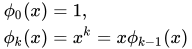
the desired sum can be expressed in terms of them and the simplest functions and :
See Fox and Parker[4] for more information and stability analyses.
Examples
edit
Horner as a special case of Clenshaw
edit
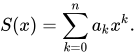
A particularly simple case occurs when evaluating a polynomial of the form
The functions are simply
and are produced by the recurrence coefficients and .
In this case, the recurrence formula to compute the sum is
and, in this case, the sum is simply
which is exactly the usual Horner's method.
The coefficients in the recursion relation for the Chebyshev polynomials are
with the initial conditions
Thus, the recurrence is
and the final results are
An equivalent expression for the sum is given by
Meridian arc length on the ellipsoid
edit
Clenshaw summation is extensively used in geodetic applications.[2] A simple application is summing the trigonometric series to compute the meridian arc distance on the surface of an ellipsoid. These have the form
Leaving off the initial term, the remainder is a summation of the appropriate form. There is no leading term because .
The recurrence relation for is
making the coefficients in the recursion relation
and the evaluation of the series is given by
The final step is made particularly simple because , so the end of the recurrence is simply ; the term is added separately:
Note that the algorithm requires only the evaluation of two trigonometric quantities and .
Difference in meridian arc lengths
edit
Sometimes it necessary to compute the difference of two meridian arcs in a way that maintains high relative accuracy. This is accomplished by using trigonometric identities to write
Clenshaw summation can be applied in this case[5]
provided we simultaneously compute
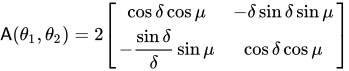
and perform a matrix summation,
where
The first element of is the average
value of and the second element is the average slope.
satisfies the recurrence
relation
where
takes the place of in the recurrence relation, and .
The standard Clenshaw algorithm can now be applied to yield
where are 2×2 matrices. Finally we have
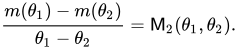
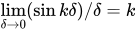
This technique can be used in the limit and to simultaneously compute and the derivative, provided that, in evaluating and , we take .
Suanjing. Clenshaw algorithm to evaluate polynomials in Chebyshev form De Boor's algorithm to evaluate splines in B-spline form De Casteljau's algorithm to evaluate
plotted below: Bézier curve De Boor's algorithm Horner scheme to evaluate polynomials in monomial form Clenshaw algorithm to evaluate polynomials in Chebyshev
He is known for the Clenshaw algorithm (1955) and Clenshaw–Curtis quadrature (1960). In a 1984 paper Beyond Floating Point, Clenshaw and Frank W. J. Olver
_{n=0}^{N}a_{n}T_{n}(x).} Polynomials in Chebyshev form can be evaluated using the Clenshaw algorithm. Polynomials denoted C n ( x ) {\displaystyle C_{n}(x)} and S n (
which is solved by the QR algorithm. This algorithm was popular, but significantly more efficient algorithms exist. Algorithms based on the Newton–Raphson
such an algorithm was put forward by C. W. Clenshaw and F. W. J. Olver in a paper published in 1980. In the problem of developing algorithms for computing


















![{\displaystyle p_{n}(x)={\tfrac {1}{2}}\left[a_{0}+b_{0}(x)-b_{2}(x)\right].}](https://wikimedia.org/api/rest_v1/media/math/render/svg/7fbaa72b9278a45699dd9756328f7a6c18b65bf9)
















![{\displaystyle {\begin{aligned}\delta &={\tfrac {1}{2}}(\theta _{1}-\theta _{2}),\\[1ex]\mu &={\tfrac {1}{2}}(\theta _{1}+\theta _{2}),\\[1ex]{\mathsf {F}}_{k}(\theta _{1},\theta _{2})&={\begin{bmatrix}\cos k\delta \sin k\mu \\{\dfrac {\sin k\delta }{\delta }}\cos k\mu \end{bmatrix}}.\end{aligned}}}](https://wikimedia.org/api/rest_v1/media/math/render/svg/f1e326c30c4478baf1107fd9fd70378db09f7742)





![{\displaystyle {\begin{aligned}{\mathsf {B}}_{n+1}&={\mathsf {B}}_{n+2}={\mathsf {0}},\\[1ex]{\mathsf {B}}_{k}&=C_{k}{\mathsf {I}}+{\mathsf {A}}{\mathsf {B}}_{k+1}-{\mathsf {B}}_{k+2},\qquad \mathrm {for\ } n\geq k\geq 1,\\[1ex]{\mathsf {M}}(\theta _{1},\theta _{2})&=C_{0}{\begin{bmatrix}\mu \\1\end{bmatrix}}+{\mathsf {B}}_{1}{\mathsf {F}}_{1}(\theta _{1},\theta _{2}),\end{aligned}}}](https://wikimedia.org/api/rest_v1/media/math/render/svg/16631720cd2ef43fa954497b1cde822af18fcc46)