

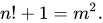
Brocard's problem is a problem in mathematics that seeks integer values of such that is a perfect square, where is the factorial. Only three values of are known — 4, 5, 7 — and it is not known whether there are any more. Though research has extended far beyond n > 7, no additional solutions to the equation n! + 1 = m2 are known.


More formally, it seeks pairs of integers and such thatThe problem was posed by Henri Brocard in a pair of articles in 1876 and 1885,[1][2] and independently in 1913 by Srinivasa Ramanujan.[3]

Brown numbers
editPairs of the numbers that solve Brocard's problem were named Brown numbers by Clifford A. Pickover in his 1995 book Keys to Infinity, after learning of the problem from Kevin S. Brown.[4] As of October 2022, there are only three known pairs of Brown numbers:

based on the equalities
Paul Erdős conjectured that no other solutions exist.[5] Computational searches have found no further solutions with .[6][7][8]

Connection to the abc conjecture
editIt would follow from the abc conjecture that there are only finitely many Brown numbers.[9] More generally, it would also follow from the abc conjecture that has only finitely many solutions, for any given integer ,[10] and that has only finitely many integer solutions, for any given polynomial of degree at least 2 with integer coefficients.[11]


References
edit- ^ Brocard, H. (1876), "Question 166", Nouv. Corres. Math., 2: 287
- ^ Brocard, H. (1885), "Question 1532", Nouv. Ann. Math., 4: 391
- ^ Ramanujan, Srinivasa (2000), "Question 469", in Hardy, G. H.; Aiyar, P. V. Seshu; Wilson, B. M. (eds.), Collected papers of Srinivasa Ramanujan, Providence, Rhode Island: AMS Chelsea Publishing, p. 327, ISBN 0-8218-2076-1, MR 2280843
- ^ Pickover, Clifford A. (1995), Keys to Infinity, John Wiley & Sons, p. 170
- ^ Erdős, Paul (1963), "Quelques problèmes de la théorie des nombres" (PDF), in Chabauty, C.; Chatelet, A.; Chatelet, F.; Descombes, R.; Pisot, C.; Poitou, G. (eds.), Introduction à la théorie des nombres, Monographies de l'Enseignement Mathématique (in French), vol. 6, University of Geneva, pp. 81–135; see problème 67, p. 129
- ^ Berndt, Bruce C.; Galway, William F. (2000), "On the Brocard–Ramanujan Diophantine equation n! + 1 = m2" (PDF), Ramanujan Journal, 4 (1): 41–42, doi:10.1023/A:1009873805276, MR 1754629, S2CID 119711158, archived from the original (PDF) on 2017-07-03
- ^ Matson, Robert (2017), "Brocard's Problem 4th Solution Search Utilizing Quadratic Residues" (PDF), Unsolved Problems in Number Theory, Logic and Cryptography, archived from the original (PDF) on 2018-10-06, retrieved 2017-05-07
- ^ Epstein, Andrew; Glickman, Jacob (2020), C++ Brocard GitHub Repository
- ^ Overholt, Marius (1993), "The Diophantine equation n! + 1 = m2", The Bulletin of the London Mathematical Society, 25 (2): 104, doi:10.1112/blms/25.2.104, MR 1204060
- ^ Dąbrowski, Andrzej (1996), "On the Diophantine equation x! + A = y2", Nieuw Archief voor Wiskunde, 14 (3): 321–324, MR 1430045
- ^ Luca, Florian (2002), "The Diophantine equation P(x) = n! and a result of M. Overholt" (PDF), Glasnik Matematički, 37(57) (2): 269–273, MR 1951531
Further reading
edit- Guy, R. K. (2004), "D25: Equations involving factorial ", Unsolved Problems in Number Theory (3rd ed.), New York: Springer-Verlag, pp. 301–302
- Makki Naciri, Abderrahim (2024), "On the variant Q(n!)=P(x) of the Brocard-Ramanujan Diophantine equation.", Ramanujan Journal, 65 (2): 1791–1798, doi:10.1007/s11139-024-00960-0
External links
edit- Weisstein, Eric W., "Brocard's Problem" ("Brown Numbers") at MathWorld.
- Copeland, Ed, "Brown Numbers", Numberphile, Brady Haran, archived from the original on 2014-11-09, retrieved 2013-04-06
