In quantum computing, the Brassard–Høyer–Tapp (BHT) algorithm is a quantum algorithm that solves the collision problem. In this problem, one is given n and an 2-to-1 function and needs to find two inputs that f maps to the same output. The BHT algorithm only makes queries to f, which matches the lower bound of in the black box model.[1] The algorithm can be generalized to r-to-1 function with a complexity of .[2]



The algorithm was discovered by Gilles Brassard, Peter Høyer, and Alain Tapp in 1997.[3] It uses Grover's algorithm, which was discovered the year before.
Algorithm
editIntuitively, the algorithm combines the square root speedup from the birthday paradox using (classical) randomness with the square root speedup from Grover's (quantum) algorithm.
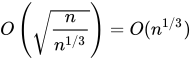
First, n1/3 inputs to f are selected at random and f is queried at all of them. If there is a collision among these inputs, then we return the colliding pair of inputs. Otherwise, all these inputs map to distinct values by f. Then Grover's algorithm is used to find a new input to f that collides. Since there are n inputs to f and n1/3 of these could form a collision with the already queried values, Grover's algorithm can find a collision with extra queries to f.[3]
See also
editReferences
edit- ^ Ambainis, A. (2005). "Polynomial Degree and Lower Bounds in Quantum Complexity: Collision and Element Distinctness with Small Range" (PDF). Theory of Computing. 1 (1): 37–46. doi:10.4086/toc.2005.v001a003.
- ^ Kutin, S. (2005). "Quantum Lower Bound for the Collision Problem with Small Range". Theory of Computing. 1 (1): 29–36. doi:10.4086/toc.2005.v001a002.
- ^ a b Brassard, Gilles; Høyer, Peter; Tapp, Alain (1998), "Quantum Algorithm for the Collision Problem", in Lucchesi, Claudio L.; Moura, Arnaldo V. (eds.), LATIN '98: Theoretical Informatics, Third Latin American Symposium, Campinas, Brazil, April, 20-24, 1998, Proceedings, Lecture Notes in Computer Science, vol. 1380, Springer, pp. 163–169, arXiv:quant-ph/9705002, doi:10.1007/BFb0054319, S2CID 3116149
