In economics, assignment valuation is a kind of a utility function on sets of items. It was introduced by Shapley[1] and further studied by Lehmann, Lehmann and Nisan,[2] who use the term OXS valuation (not to be confused with XOS valuation). Fair item allocation in this setting was studied by Benabbou, Chakraborty, Elkind, Zick and Igarashi.[3][4]
Assignment valuations correspond to preferences of groups. In each group, there are several individuals; each individual attributes a certain numeric value to each item. The assignment-valuation of the group to a set of items S is the value of the maximum weight matching of the items in S to the individuals in the group.
The assignment valuations are a subset of the submodular valuations.
Example
editSuppose there are three items and two agents who value the items as follows:
| x | y | z | |
|---|---|---|---|
| Alice: | 5 | 3 | 1 |
| George: | 6 | 2 | 4.5 |
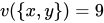
Then the assignment-valuation v corresponding to the group {Alice,George} assigns the following values:
- - since the maximum-weight matching assigns x to George.
- - since the maximum-weight matching assigns y to Alice.
- - since the maximum-weight matching assigns z to George.
- - since the maximum-weight matching assigns x to George and y to Alice.
- - since the maximum-weight matching assigns z to George and x to Alice.
- - since the maximum-weight matching assigns z to George and y to Alice.
- - since the maximum-weight matching assigns z to George and x to Alice.





References
edit- ^ Shapley, Lloyd S. (1962). "Complements and substitutes in the opttmal assignment problem". Naval Research Logistics Quarterly. 9 (1): 45–48. doi:10.1002/nav.3800090106.
- ^ Lehmann, Benny; Lehmann, Daniel; Nisan, Noam (2006-05-01). "Combinatorial auctions with decreasing marginal utilities". Games and Economic Behavior. Mini Special Issue: Electronic Market Design. 55 (2): 270–296. doi:10.1016/j.geb.2005.02.006. ISSN 0899-8256.
- ^ Benabbou, Nawal; Chakraborty, Mithun; Elkind, Edith; Zick, Yair (2019-08-10). "Fairness Towards Groups of Agents in the Allocation of Indivisible Items".
{{cite journal}}: Cite journal requires|journal=(help) - ^ Benabbou, Nawal; Chakraborty, Mithun; Igarashi, Ayumi; Zick, Yair (2020). Finding Fair and Efficient Allocations When Valuations Don't Add Up. Lecture Notes in Computer Science. Vol. 12283. pp. 32–46. arXiv:2003.07060. doi:10.1007/978-3-030-57980-7_3. ISBN 978-3-030-57979-1. S2CID 208328700.
