In graph theory, Edmonds' algorithm or Chu–Liu/Edmonds' algorithm is an algorithm for finding a spanning arborescence of minimum weight (sometimes called an optimum branching).[1] It is the directed analog of the minimum spanning tree problem. The algorithm was proposed independently first by Yoeng-Jin Chu and Tseng-Hong Liu (1965) and then by Jack Edmonds (1967).
Algorithm
editDescription
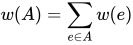
editThe algorithm takes as input a directed graph where is the set of nodes and is the set of directed edges, a distinguished vertex called the root, and a real-valued weight for each edge . It returns a spanning arborescence rooted at of minimum weight, where the weight of an arborescence is defined to be the sum of its edge weights, .


The algorithm has a recursive description. Let denote the function which returns a spanning arborescence rooted at of minimum weight. We first remove any edge from whose destination is . We may also replace any set of parallel edges (edges between the same pair of vertices in the same direction) by a single edge with weight equal to the minimum of the weights of these parallel edges.

Now, for each node other than the root, find the edge incoming to of lowest weight (with ties broken arbitrarily). Denote the source of this edge by . If the set of edges does not contain any cycles, then .




Otherwise, contains at least one cycle. Arbitrarily choose one of these cycles and call it . We now define a new weighted directed graph in which the cycle is "contracted" into one node as follows:


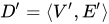
The nodes of are the nodes of not in plus a new node denoted .


- If is an edge in with and (an edge coming into the cycle), then include in a new edge , and define .
- If is an edge in with and (an edge going away from the cycle), then include in a new edge , and define .
- If is an edge in with and (an edge unrelated to the cycle), then include in a new edge , and define .







For each edge in , we remember which edge in it corresponds to.
Now find a minimum spanning arborescence of using a call to . Since is a spanning arborescence, each vertex has exactly one incoming edge. Let be the unique incoming edge to in . This edge corresponds to an edge with . Remove the edge from , breaking the cycle. Mark each remaining edge in . For each edge in , mark its corresponding edge in . Now we define to be the set of marked edges, which form a minimum spanning arborescence.


Observe that is defined in terms of , with having strictly fewer vertices than . Finding for a single-vertex graph is trivial (it is just itself), so the recursive algorithm is guaranteed to terminate.

Running time
editThe running time of this algorithm is . A faster implementation of the algorithm due to Robert Tarjan runs in time for sparse graphs and for dense graphs. This is as fast as Prim's algorithm for an undirected minimum spanning tree. In 1986, Gabow, Galil, Spencer, and Tarjan produced a faster implementation, with running time .



References
edit- ^ The algorithm is applicable to finding a minimum spanning forest with given roots. However, when searching for the minimum spanning forest among all -component spanning forests, a multiplier arises in the complexity of the algorithm , corresponding to the choice of a subset of vertices designated as roots. This makes it unsuitable for such a task. Even when constructing a minimum spanning tree, regardless of the root, the algorithm must be used times, sequentially assigning each vertex as the root. An efficient algorithm for finding minimum spanning forests that solves the root assignment problem is presented in (https://link.springer.com/article/10.1007/s10958-023-06666-w). It builds a sequence of minimal -component spanning forests for all up to the minimum spanning tree. The Chu-Liu/Edmonds algorithm is a component of it.


- Chu, Yeong-Jin; Liu, Tseng-Hong (1965), "On the Shortest Arborescence of a Directed Graph" (PDF), Scientia Sinica, XIV (10): 1396–1400
- Edmonds, J. (1967), "Optimum Branchings", Journal of Research of the National Bureau of Standards Section B, 71B (4): 233–240, doi:10.6028/jres.071b.032
- Tarjan, R. E. (1977), "Finding Optimum Branchings", Networks, 7: 25–35, doi:10.1002/net.3230070103
- Camerini, P.M.; Fratta, L.; Maffioli, F. (1979), "A note on finding optimum branchings", Networks, 9 (4): 309–312, doi:10.1002/net.3230090403
- Gibbons, Alan (1985), Algorithmic Graph Theory, Cambridge University press, ISBN 0-521-28881-9
- Gabow, H. N.; Galil, Z.; Spencer, T.; Tarjan, R. E. (1986), "Efficient algorithms for finding minimum spanning trees in undirected and directed graphs", Combinatorica, 6 (2): 109–122, doi:10.1007/bf02579168, S2CID 35618095
- Buslov, V. (2023), "Algorithm for Sequential Construction of Spanning Minimal Directed Forests", Journal of Mathematical Sciences, 275: 117–129, doi:10.1007/s10958-023-06666-w
External links
edit- Edmonds's algorithm ( edmonds-alg ) – An implementation of Edmonds's algorithm written in C++ and licensed under the MIT License. This source is using Tarjan's implementation for the dense graph.
- NetworkX, a python library distributed under BSD, has an implementation of Edmonds' Algorithm.
- (spanning-forest-builder 0.0.2) – Library for constructing oriented forests of minimum weight.
